Analysis of the Correlation between Pseudomonas aeruginosa Resistance Genes and Virulence Genes in Burn Patients Using Next-Generation Sequencing
DOI:
https://doi.org/10.71321/dpqzt488Keywords:
Burn, Pseudomonas aeruginosa (PA), Next-generation sequencing (NGS), Drug resistance genes, Virulence genesAbstract
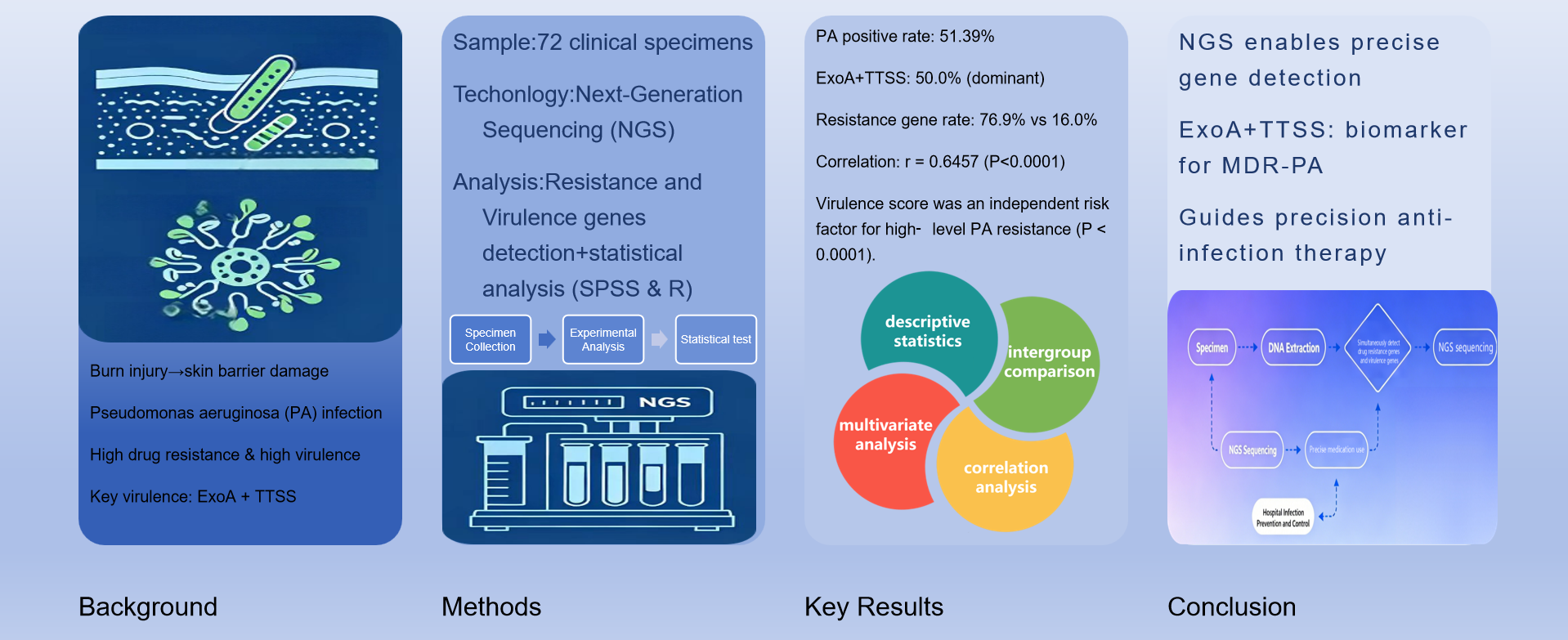
Objective: To analyze the distribution and correlation of drug resistance genes and virulence genes of Pseudomonas aeruginosa (PA) isolated from burn patients using next-generation sequencing (NGS), providing molecular evidence for precise clinical diagnosis and treatment.
Methods: A retrospective study was conducted on 72 suspected PA infection specimens and clinical data collected from the Department of Burn and Wound Repair Surgery at the First Affiliated Hospital of Anhui Medical University between January 2022 and December 2025. NGS was employed to detect drug resistance and virulence genes, with statistical analysis performed using SPSS 26.0 and R language.
Results: The positive detection rate of PA was 51.39% (37/72), with wounds being the primary infection site (positive rate: 83.8%). The infection rate was highest among moderate burn patients (58.3%). PA exhibited a 100.0% resistance rate to cefazolin, and among the 25 drug-sensitive strains, 36.0% were multidrug-resistant. A trend toward prevalence of PA resistant to carbapenems was observed. Among the 52 specimens tested for virulence genes, the overall carriage rate was 51.9% (27/52), with the ExoA+TTSS composite genotype being predominant (50.0%, 26/52). The detection rate of drug resistance genes in ExoA+TTSS-positive strains (76.9%) was significantly higher than in non-virulence gene-positive strains (16.0%; χ²=19.9086, P<0.0001). The virulence factor score showed a moderately strong positive correlation with the number of drug resistance genes (r=0.6457, P<0.0001) and was identified as an independent risk factor for drug resistance gene carriage (OR=2.1494–9.7401, P<0.0001).
Conclusion: In burn patients, PA infections predominantly occur at the wound site, with prominent resistance and multidrug resistance phenomena; PA virulence genes exhibit a significant positive correlation with resistance genes, and strains with the ExoA+TTSS composite genotype demonstrate higher resistance; NGS enables simultaneous analysis of PA genetic characteristics, providing critical support for precision anti-infection therapy.
References
[1] Yao Yongming, Ren Chao. Burn Infection and Immune Disorders: A New Perspect-ive in Translational Medicine from Pathogenesis to Precision Diagnosis and Treat-ment[J]. Chinese Journal of Burn and Wound Care, 2026, 42(2): 119-125. https://doi.org/10.3760/cma.j.cn501225-20251104-00457.
[2] Li Suli, Hua Chuan. Research Progress on Multidrug Resistance and Pan-Resistan-ce of Pseudomonas aeruginosa[J]. Shanxi Medical Journal (Second Half Monthly Issue), 2013, 42(8): 891-892.
[3] Huang Jingjing, Xiao Meng, Xu Yingchun.Application of next-generation sequencing technology in microbiology and infectious diseases[J]. Journal of Union Medical College, 2018, 9(5): 5. https://doi.org/10.3969/j.issn.1674-9081.2018.05.014.
[4] Hoque M , Jahan M, Hossain M A, et al. Genomic diversity and molecular epide-miology of a multidrug resistant Pseudomonas aeruginosa DMC30b isolated from hospitalized burn patient in Bangladesh[J]. bioRxiv, 2022. https://doi.org/10.1101/2022.07.06.498939.
[5] Wang Lingshuang. Application of mussel-inspired adhesive hydrogel in wound repair [D]. Southwest University, 2024.
[6] Wei Quanzhen, Zhang Huizhen, Liu Lihua. Prevention and control of MRSA hospit-al-acquired infections in wound surfaces of burn and trauma patients[J]. Chinese Journal of Hospital Infection, 2007,17(7): 3. https://doi.org/10.3321/j.issn:1005-4529.2007.07.022.
[7] Aroca Molina K J, Gutiérrez S J, Benítez-Campo N, et al. Genomic Differences Associated with Resistance and Virulence in Pseudomonas aeruginosa Isolates from Clinical and Environmental Sites[J]. Microorganisms, 2024, 12(6). https://doi.org/10.3390/microorganisms12061116.
[8] Bi Wenzhi, Zhou Tieli. Research progress on bacterial pathogenicity, current status of drug resistance, and mechanisms of resistance [J]. Zhejiang Medical Journal, 2018,40(20):5. https://doi/10.12056/j.issn.1006-2785.2018.40.20.2018-1548
[9] MartínezE, Im H, Mohasin M, et al. The Oxylipin Dependent Quorum Sensing Sys-tem enhances Pseudomonas aeruginosa dissemination during burn-associated infe-ction[J]. PLoS Pathogens, 2026, 22(1). https://doi.org/10.1371/journal.ppat.1013885.
[10] Reid O. Burn wound infections[J]. Clinical Microbiology Reviews, 2006, 19(2): 403-434. https://doi.org/10.1128/cmr.19.2.403-434.2006.
[11] Zhou Kai, Shi Cuixiao, Song GuoBin, Huang Ying,Xu Yuanhong. Carriage, expres-sion, and correlation with drug resistance of QS system regulatory genes and viru-lence genes in Pseudomonas aeruginosa[D]. Hefei: Anhui Medical University, 2022. https://doi.org/10.19405/j.cnki.issn1000-1492.2022.05.014.
[12] Weng Xingbi, Mi Zuhuang. Mobile genetic elements: vectors for drug resistance genes[J]. China Journal of Zoonotic Diseases, 2013, 29(4): 9. https://doi.org/10.3969/cjz.j.issn.1002-2694.2013.04.015.
[13] Xu Y, Wang Y, Zhang H, et al. Detection of virulence genes and drug resistance genes in Pseudomonas aeruginosa isolates from elderly patients with acquired pneumonia[J]. Chinese Journal of Clinical Infectious Diseases, 2019. https://doi.org/10.3760/cma.j.issn.1674-2397.2019.01.011.
[14] Zhuo Chao, Wang Luxia, Xiao Shunian, et al. Clinical significance of virulence genes associated with the Pseudomonas aeruginosa type III secretion system[J]. Chinese Journal of Burns, 2010(5): 6. https://doi.org/10.3760/cma.j.issn.1009-2587.2010.05.009.
Type
Published
Issue
Section
License
Copyright (c) 2026 Cell Conflux

This work is licensed under a Creative Commons Attribution 4.0 International License.