Management of Difficulty in Decannulation for Patients with Long-Term Tracheostomy Tubes Following Brain Diseases
DOI:
https://doi.org/10.71321/eakbax42Keywords:
Brain, Diseases tracheotomy, Laryngotracheal stenosis, Difficult decannulationAbstract
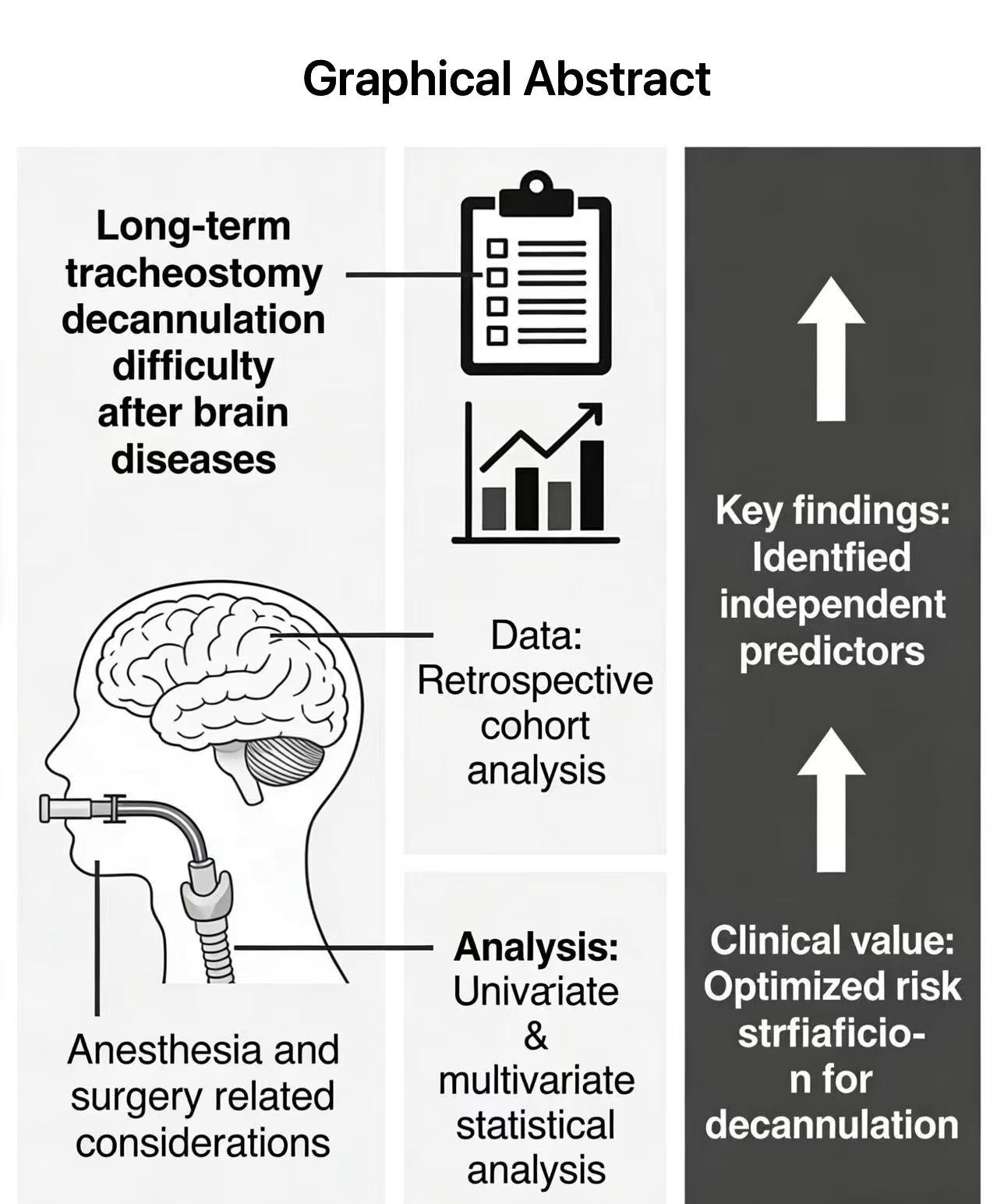
Objective: To investigate the etiology of difficult decannulation in patients with long-term tracheostomy following brain-related diseases, and to explore the preoperative examination and assessment, selection of surgical indications, surgical and postoperative management methods. This aims to provide a scientific basis for facilitating successful decannulation, improving patients' quality of life, and guiding clinical practitioners in the management of such cases.
Methods: A retrospective analysis was conducted on 27 patients who were hospitalized in our department from May to December 2025 and had experienced failed decannulation after long-term tracheostomy. Preoperative examination and assessment included electronic laryngoscopy and laryngotracheal CT three-dimensional reconstruction. Electronic laryngoscopy was simultaneously used to assess swallowing function, including the Penetration-Aspiration Scale score, Murray Secretion Scale score, vallecula and pyriform sinus residue grading, and swallowing disability grading and classification. The surgical procedure involved endoscopic-assisted resection of laryngeal and tracheal granulation tissue via a supporting laryngoscope under general anesthesia.
Results: The primary cause of laryngotracheal stenosis leading to decannulation failure in patients with long-term tracheostomy due to brain diseases was obstruction from granulation tissue hyperplasia within the larynx and trachea, followed by restricted bilateral vocal cord abduction. Based on detailed preoperative examinations and assessments, all 27 patients in this group were deemed suitable candidates for surgery. They successfully underwent endoscopic-assisted resection of laryngeal and tracheal granulation tissue via a supporting laryngoscope under general anesthesia without any complications. Decannulation was successfully achieved in all patients within 7 to 10 days postoperatively.
Conclusions: 1) Electronic fiberoptic laryngoscopy and laryngotracheal CT three-dimensional reconstruction are effective methods for preoperative examination and evaluation. 2) Appropriate surgical candidates can be selected based on these two examinations. 3) Endoscopic-assisted resection of laryngotracheal granulation lesions via a supporting laryngoscope under general anesthesia is a safe and effective method to resolve decannulation difficulties in such patients.
References
[1] Marcet-Gonzalez J, Barton G, Lambert E. Severity of sialorrhea and tracheal secretions in infants and toddlers with a tracheostomy with a focus on quality of life. American Journal of Otolaryngology. 2021;42(6):103074. https://doi.org/10.1016/j.amjoto.2021.103074
[2] Kumar V, Malhotra V, Sinha V. Evaluation of individual quality of life (QOL) among patients with tracheostomy using WHO-QOL BREF questionnaire. Indian Journal of Otolaryngology and Head & Neck Surgery. 2022;74(Suppl 3):5207-5216. https://doi.org/10.1007/s12070-020-02298-0
[3] Lakshmanan S, Manimaran V, Mohanraj L. Quality of life in non-ventilated tracheostomised patients. Indian Journal of Otolaryngology and Head & Neck Surgery. 2023;75(2):282-286. https://doi.org/10.1007/s12070-022-03310-7
[4] Freeman-Sanderson AL, Togher L, Elkins MR, Phipps PR. Quality of life improves for tracheostomy patients with return of voice: a mixed methods evaluation of the patient experience across the care continuum. Intensive and Critical Care Nursing. 2018;46:10-16. https://doi.org/10.1016/j.iccn.2018.02.004
[5] Mizuno K, Takeuchi M, Kishimoto Y, et al. Indications and outcomes of paediatric tracheotomy: a descriptive study using a Japanese claims database. BMJ open. 2019;9(12):e031816. https://doi.org/10.1136/bmjopen-2019-0318166.
[6] Morimoto N, Maekawa T, Kubota M, et al. Challenge for management without tracheostomy tube after laryngo-tracheal separation in children with neurological disorders. Laryngoscope Investigative Otolaryngology. 2021;6(2):332-339. https://doi.org/10.1002/lio2.534
[7] Kadasah SK, Alshammari AM, Alharbi NS, et al. Fractured tracheostomy tube as a foreign body in a pediatric patient: a case report and review of literature. Journal of Surgical Case Reports. 2025;2025(4):rjaf194. https://doi.org/10.1093/jscr/rjaf194
[8] Elkholy KO, Akhtar H, Landa E, et al. A case of pneumomediastinum and pneumoperitoneum with concurrent massive subcutaneous emphysema due to repositioning of a tracheostomy tube. Cureus. 2019;11(1):e3869. https://doi.org/10.7759/cureus.3881
[9] Wang T, Tai J, Hu R, et al. Impacts of long-term nasogastric tube feeding and tracheostomy on pharyngeal and laryngeal structure in ABI patients: an FEES study. European Journal of Medical Research. 2025;30(1):109. https://doi.org/10.1186/s40001-025-02375-z
[10] Kumar VA, Reddy BU, Kumar VAK, et al. Speech and swallowing function outcome following early tracheostomy in patients who underwent neurosurgical intervention. Indian Journal of Critical Care Medicine. 2018;22(6):427-431. https://doi.org/10.4103/ijccm.IJCCM_31_18
[11] Zhang X, Zhou H, Shen H, et al. Pulmonary infection in traumatic brain injury patients undergoing tracheostomy: predicators and nursing care. BMC pulmonary medicine. 2022;22(1):130. https://doi.org/10.1186/s12890-022-01928-w
[12] Phookan J, Talukdar R. A study on quality of life in post-tracheostomised patients. Indian Journal of Otolaryngology and Head & Neck Surgery. 2023;75(2):848-856. https://doi.org/10.1007/s12070-022-03311-6
Type
Published
Issue
Section
License
Copyright (c) 2026 Head and Neck Diseases Conflux

This work is licensed under a Creative Commons Attribution 4.0 International License.
How to Cite