Interception of Lipid-rich Emboli Using an Embolic Protection Device during Carotid Artery Stenting: A Case Report
DOI:
https://doi.org/10.71321/94w1v584Keywords:
Carotid Artery Stenting; Embolic Protection Device, Severe Carotid Artery Stenosis, Transient Ischemic AttackAbstract
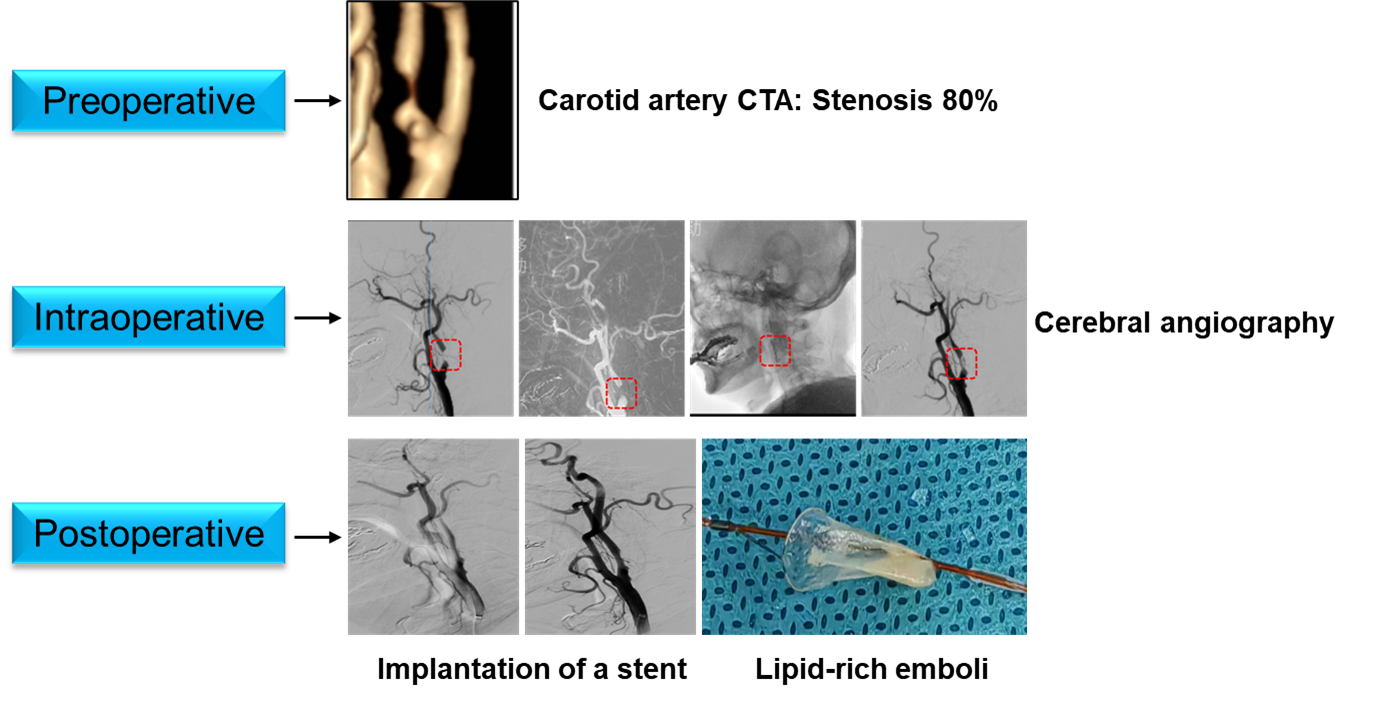
Carotid artery stenosis is a major risk factor for ischemic stroke, and carotid artery stenting (CAS) has become a crucial minimally invasive treatment, especially for patients with poor surgical tolerance. This case report focuses on a 73-year-old male patient with severe right internal carotid artery stenosis (80%), complicated by hypertension, a history of cerebral infarction, and recurrent transient ischemic attack (TIA). Preoperative dual anti-platelet therapy was administered, and CAS was performed using a distal filter-type embolic protection device (EPD) to intercept lipid-rich embolism. Importantly, transient bradycardia and hypotension occurred due to carotid sinus reflex but were successfully managed with atropine and dopamine. Postoperative digital subtraction angiography (DSA) showed that the residual stenosis rate was reduced from 80% to <10%, with unobstructed blood flow. During 1-month follow-up, the patient’s symptoms resolved, and carotid ultrasound confirmed no in-stent re-stenosis. This case demonstrates that CAS with EPD is safe and effective for severe carotid artery stenosis, as the EPD can significantly reduce the risk of cerebral embolism by intercepting dislodged emboli. The findings provide valuable clinical experience for improving treatment outcomes and patient prognosis in similar cases.
References
[1] GBD 2019 Stroke Collaborators. Global, regional, and national burden of stroke and its risk factors, 1990-2019: a systematic analysis for the Global Burden of Disease Study 2019. Lancet Neurol. 2021;20(10):795-820. https://doi.org/10.1016/S1474-4422(21)00252-0
[2] Zhang, C., Wang, J., Ding, S., Gan, G., Li, L., et al. Relationship between lifestyle and metabolic factors and carotid atherosclerosis: A survey of 47,063 fatty and non-fatty liver patients in China. Front Cardiovasc Med. 2022;9:935185. https://doi.org/10.3389/fcvm.2022.935185
[3] Bedi, Varinder Singh, Nikhil Sharma. Carotid artery stenosis: stroke prevention procedure-indications, controversies, and challenges. Indian J Thorac Cardiovasc Surg. 2024;40(1):3-6. https://doi.org/10.1007/s12055-023-01603-7
[4] Rerkasem A, Orrapin S, Howard DP, Rerkasem K. Carotid endarterectomy for symptomatic carotid stenosis. Cochrane Database Syst Rev. 2020;9(9):CD001081. https://doi.org/10.1002/14651858.CD001081.pub4
[5] Mei F, Zhang W, Jiang P, Tan C, Cui Y, Fan J, et al. Comparison of the treatment strategies for symptomatic chronic internal carotid artery occlusion. J Vasc Surg. 2025;81(2):494-504.e2. https://doi.org/10.1016/j.jvs.2024.05.062
[6] White CJ, Brott TG, Gray WA, Heck D, Jovin T, Lyden SP, et al. Carotid Artery Stenting: JACC State-of-the-Art Review. J Am Coll Cardiol. 2022;80(2):155-170. https://doi.org/10.1016/j.jacc.2022.05.007
[7] Heck D, Jost A. Carotid stenosis, stroke, and carotid artery revascularization. Prog Cardiovasc Dis. 2021;65:49-54. https://doi.org/10.1016/j.pcad.2021.03.005
[8] Guo Z, Liu C, Huang K, Yu N, Peng M, Starnes BW, et al. Meta-analysis of redo stenting versus endarterectomy for in-stent stenosis after carotid artery stenting. J Vasc Surg. 2021;73(4):1282-1289. https://doi.org/10.1016/j.jvs.2020.07.102
[9] Müller MD, Lyrer PA, Brown MM, Bonati LH. Carotid Artery Stenting Versus Endarterectomy for Treatment of Carotid Artery Stenosis. Stroke. 2021;52(1):e3-e5. https://doi.org/10.1161/STROKEAHA.120.030521
[10] Halliday A, Bulbulia R, Bonati LH, Chester J, Cradduck-Bamford A, Peto R, et al. Second asymptomatic carotid surgery trial (ACST-2): a randomised comparison of carotid artery stenting versus carotid endarterectomy. Lancet. 2021;398(10305):1065-1073. https://doi.org/10.1016/S0140-6736(21)01910-3
[11] Sun Y, Ding Y, Meng K, Han B, Wang J, Han Y. Comparison the effects of carotid endarterectomy with carotid artery stenting for contralateral carotid occlusion. PLoS One. 2021;16(5):e0250580. Published 2021 May 20. https://doi.org/10.1371/journal.pone.0250580
[12] Reiff T, Eckstein HH, Mansmann U, Jansen O, Fraedrich G, Mudra H, et al. Carotid endarterectomy or stenting or best medical treatment alone for moderate-to-severe asymptomatic carotid artery stenosis: 5-year results of a multicentre, randomised controlled trial. Lancet Neurol. 2022;21(10):877-888. https://doi.org/10.1016/S1474-4422(22)00290-3
[13] Wang SX, Marcaccio CL, Patel PB, Giles KA, Soden PA, Schermerhorn ML, et al. Distal embolic protection use during transfemoral carotid artery stenting is associated with improved in-hospital outcomes. J Vasc Surg. 2023 Jun;77(6):1710-1719.e6. doi: 10.1016/j.jvs.2023.01.210
[14] Kim MS, Kim WJ, Khera AV, Kim JY, Yon DK, Lee SW, et al. Association between adiposity and cardiovascular outcomes: an umbrella review and meta-analysis of observational and Mendelian randomization studies. Eur Heart J. 2021;42(34):3388-3403. https://doi.org/10.1093/eurheartj/ehab454
[15] Gorgulu S, Sahin M, Norgaz NT, Pala S, Sarı M, Yalcin AA, et al. Carotid artery stenting without embolic protection: A randomized multicenter trial (the CASWEP trial). Interv Neuroradiol. 2023;29(4):419-425. https://doi.org/10.1177/15910199221094388
[16] Giannopoulos S, Sagris M, Giannopoulos S, Tzoumas A, Kokkinidis DG, Texakalidis P, et al. Embolic protection devices for carotid artery stenting: A network meta-analysis. Vascular. 2024;32(2):447-457. https://doi.org/10.1177/17085381221140616
[17] Wang SK, Severance S, Westin GG, Maijub JG, Gupta AK, Sawchuk AP, et al. Perioperative and 1-year transcarotid revascularization outcomes in symptomatic patients. J Vasc Surg. 2020;72(6):2047-2053. https://doi.org/10.1016/j.jvs.2020.03.044
[18] Kadoglou NPE, Stasinopoulou M, Giannakopoulos T, Papapetrou A, Dimitriou C, Travlou A, et al. Carotid Stent Restenosis and Thrombosis in Rabbits: The Effect of Antiplatelet Agents. J Cardiovasc Pharmacol Ther. 2020;25(6):570-577. https://doi.org/10.1177/1074248420931624
[19] Ullrich H, Olschewski M, Münzel T, Gori T. Coronary In-Stent Restenosis: Predictors and Treatment. Dtsch Arztebl Int. 2021;118(38):637-644. https://doi.org/10.3238/arztebl.m2021.0254
[20] Rivard A. Real-World Treatment of In-Stent Restenosis: The Return of the Balloon. Can J Cardiol. 2024;40(7):1258-1260. https://doi.org/10.1016/j.cjca.2024.02.015
Type
Published
Data Availability Statement
Not applicable
Issue
Section
License
Copyright (c) 2026 Brain Conflux

This work is licensed under a Creative Commons Attribution 4.0 International License.
How to Cite