Association of Bedtime Milk Consumption with Adenoid Sizeand Tissue Microbiota Profiles in Children with Adenoid Hypertrophy
DOI:
https://doi.org/10.71321/r7de2v23Keywords:
milk drinking, adenoid hypertrophy, gastroesophageal reflux, microorganismsAbstract
Background: Adenoid hypertrophy is a common and frequently occurring disease in children, and the surgical rate is relatively high. Currently, the etiology is not yet clear, and it is of great significance to explore its pathogenesis and new treatment methods. To investigate the effect of milk consumption before bedtime on adenoid size and the tissue microbiota in children.
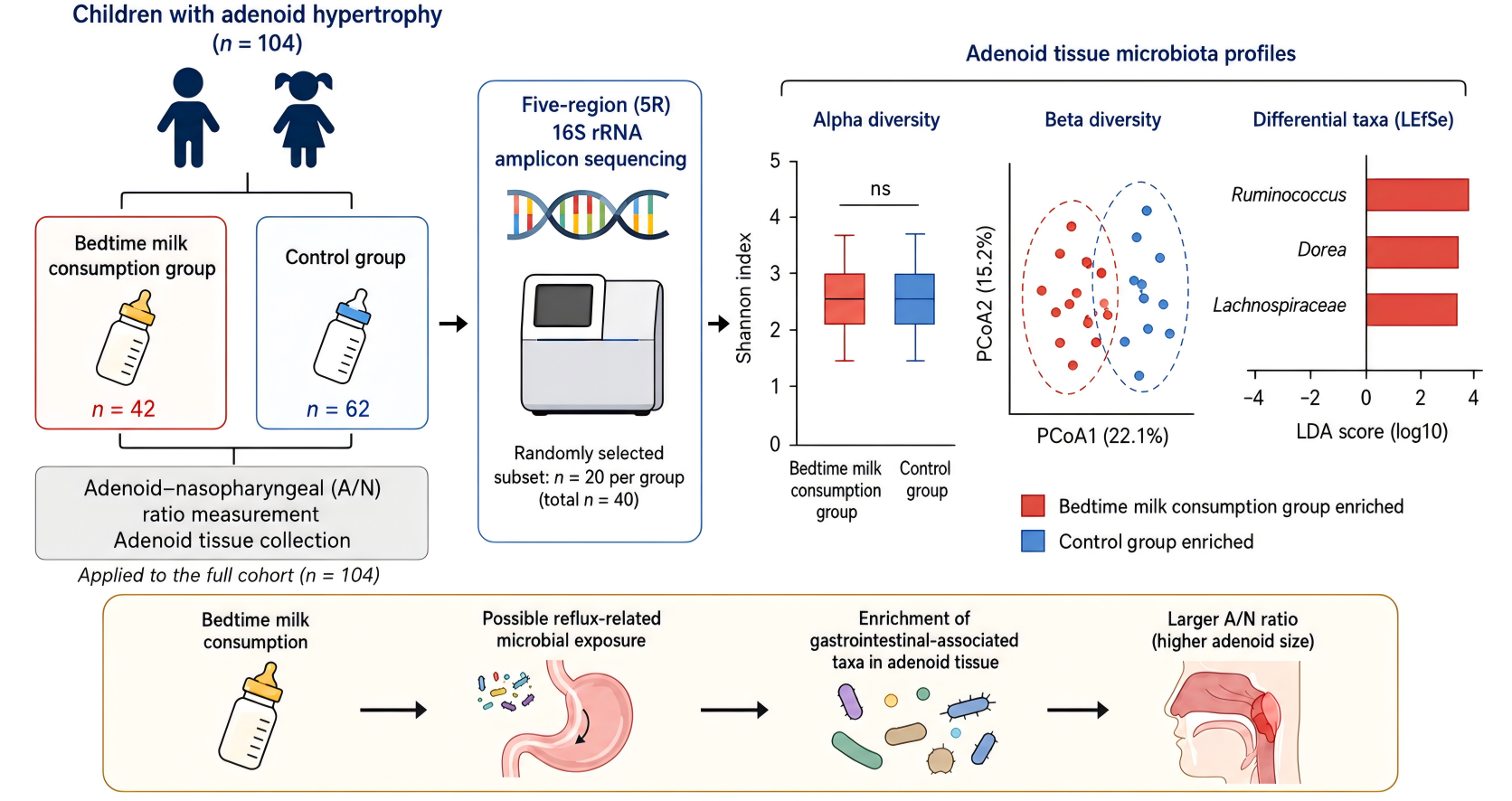
Methods: A total of 104 children who underwent surgical treatment for adenoid hypertrophy (AH) at our hospital between March 2023 and January 2024 were divided into a bedtime milk consumption group (n = 42) and a control group (n = 62) according to their milk consumption before bedtime. The adenoid-nasopharyngeal (A/N) ratio was measured, and adenoid tissue samples from a randomly selected subset of 20 participants in each group were subjected to five-region (5R) 16S rRNA amplicon sequencing.
Results: The average A/N ratio in the experimental group was 0.808 ± 0.070, vs 0.736 ± 0.037 in the control group, showing a significant difference (P < 0.001). There was no significant difference in total microbial diversity or dominant bacterial community distribution in adenoid tissue between the two groups. However, comparison revealed the experimental group's adenoid tissue was enriched in Ruminococcus, Dorea, and Lachnospiraceae, common in the gastrointestinal tract.
Conclusions: Bedtime milk consumption was associated with a larger adenoid size and altered adenoid tissue microbiota profiles in children with AH. The enrichment of gastrointestinal-associated taxa suggests a potential link with reflux-related microbial exposure, which warrants further validation.
References
[1] Nave, H., A. Gebert, and R. Pabst. Morphology and Immunology of the Human Palatine Tonsil. Anatomy and Embryology 204 (5): 367–373. https://doi.org/10.1007/s004290100210.
[2] Pereira, Lara, John Monyror, Fabiana T. Almeida, Fernanda R. Almeida, and Eliete Guerra. Prevalence of Adenoid Hypertrophy: A Systematic Review and Meta-Analysis. Sleep Medicine Reviews 38: 101–112. https://doi.org/10.1016/j.smrv.2017.06.001.
[3] Niedzielski, Artur, Lechosław Paweł Chmielik, Grażyna Mielnik-Niedzielska, Anna Kasprzyk, and Joanna Bogusławska. Adenoid Hypertrophy in Children: A Narrative Review of Pathogenesis and Clinical Relevance. BMJ Paediatrics Open 7 (1): e001710. https://doi.org/10.1136/bmjpo-2022-001710.
[4] Tamir, S. O., Y. Schwarz, I. Hazan, et al. Medical Treatment Does Not Reduce Surgery Rates in Children with Adenoid Hypertrophy. International Journal of Pediatric Otorhinolaryngology 176: 111836. https://doi.org/10.1016/j.ijporl.2023.111836.
[5] Ma, Y., L. Xie, and W. Wu. The Effects of Adenoid Hypertrophy and Oral Breathing on Maxillofacial Development: A Review of the Literature. Journal of Clinical Pediatric Dentistry 48 (1): 1–6.
[6] Hua, H. L., Y. Q. Deng, H. Huang, et al. Inflammatory Endotypes of Adenoidal Hypertrophy Based on a Cluster Analysis of Biomarkers. International Immunopharmacology 127: 111318. https://doi.org/10.1016/j.intimp.2023.111318.
[7] Liu, W., H. Jiang, X. Liu, et al. Altered Intestinal Microbiota Enhances Adenoid Hypertrophy by Disrupting the Immune Balance. Frontiers in Immunology 14: 1277351. https://doi.org/10.3389/fimmu.2023.1277351.
[8] Fuks, G., M. Elgart, A. Amir, et al. Combining 16S rRNA Gene Variable Regions Enables High-Resolution Microbial Community Profiling. Microbiome 6 (1): 17. https://doi.org/10.1186/s40168-017-0396-x.
[9] Nejman, D., I. Livyatan, G. Fuks, et al. The Human Tumor Microbiome Is Composed of Tumor Type-Specific Intracellular Bacteria. Science 368 (6494): 973–980. https://doi.org/10.1126/science.aay9189.
[10] Ma, Y., L. Xie, and W. Wu. The Effects of Adenoid Hypertrophy and Oral Breathing on Maxillofacial Development: A Review of the Literature. Journal of Clinical Pediatric Dentistry 48 (1): 1–6. [Duplicate of Reference 5; delete before submission.]
[11] Bilgili, A. M., H. Ö. Durmaz, and M. Dilber. Efficacy of Topical Azelastine and Fluticasone Dipropionate Combination in Children with Adenoid Hypertrophy. Ear, Nose & Throat Journal 102 (1): 28–34.
[12] Zhou, B., Y. Yuan, S. Zhang, et al. Intestinal Flora and Disease Mutually Shape the Regional Immune System in the Intestinal Tract. Frontiers in Immunology 11: 575. https://doi.org/10.3389/fimmu.2020.00575.
[13] Zuo, L., L. He, A. Huang, et al. Risk Factors and Antibiotic Sensitivity of Aerobic Bacteria in Chinese Children with Adenoid Hypertrophy. BMC Pediatrics 22: 553.
[14] Ren, T., D. U. Glatt, T. N. Nguyen, et al. 16S rRNA Survey Revealed Complex Bacterial Communities and Evidence of Bacterial Interference on Human Adenoids. Environmental Microbiology 15 (2): 535–547.
[15] Bogaert, D., B. Keijser, S. Huse, et al. Variability and Diversity of Nasopharyngeal Microbiota in Children: A Metagenomic Analysis. PLoS ONE 6 (2): e17035. https://doi.org/10.1371/journal.pone.0017035.
[16] Brook, I., and A. E. Gober. In Vitro Bacterial Interference in the Nasopharynx of Otitis Media-Prone and Non-Otitis Media-Prone Children. Archives of Otolaryngology–Head & Neck Surgery 126 (8): 1011–1013. https://doi.org/10.1001/archotol.126.8.1011.
[17] Shi, Y. C., S. T. Cai, Y. P. Tian, et al. Effects of Proton Pump Inhibitors on the Gastrointestinal Microbiota in Gastroesophageal Reflux Disease. Genomics, Proteomics & Bioinformatics 17 (1): 52–63. https://doi.org/10.1016/j.gpb.2018.12.004.
[18] Zhou, J., P. Shrestha, Z. Qiu, et al. Distinct Microbiota Dysbiosis in Patients with Non-Erosive Reflux Disease and Esophageal Adenocarcinoma. Journal of Clinical Medicine 9 (7): 2162. https://doi.org/10.3390/jcm9072162.
[19] Zhang, X., D. Yu, D. Wu, et al. Tissue-Resident Lachnospiraceae Family Bacteria Protect against Colorectal Carcinogenesis by Promoting Tumor Immune Surveillance. Cell Host & Microbe 31 (3): 418–432.e8.
[20] Niu, Xun, Zeng-Hong Wu, Xi-Yue Xiao, and Xiong Chen. The Relationship between Adenoid Hypertrophy and Gastroesophageal Reflux Disease: A Meta-Analysis. Medicine 97 (41): e12540. https://doi.org/10.1097/MD.0000000000012540.
[21] Sagar, M., P. Sagar, S. K. Kabra, et al. The Concatenation of Association between Gastroesophageal Reflux and Obstructive Adenotonsillar Hypertrophy. International Journal of Pediatric Otorhinolaryngology 139: 110439. https://doi.org/10.1016/j.ijporl.2020.110439.
[22] Crapko, M., J. E. Kerschner, M. Syring, et al. Role of Extra-Esophageal Reflux in Chronic Otitis Media with Effusion. The Laryngoscope 117 (8): 1419–1423
Type
Published
Issue
Section
License
Copyright (c) 2026 Head and Neck Diseases Conflux

This work is licensed under a Creative Commons Attribution 4.0 International License.
How to Cite