Transcriptomics Identify KCNJ2 as a Potential Novel Biomarker for the Postoperative Recurrence in Chronic Sinusitis
DOI:
https://doi.org/10.71321/t4rcfz38Keywords:
Chronic rhinosinusitis, RNA-seq, Macrophages, KCNJ2, RecurrenceAbstract
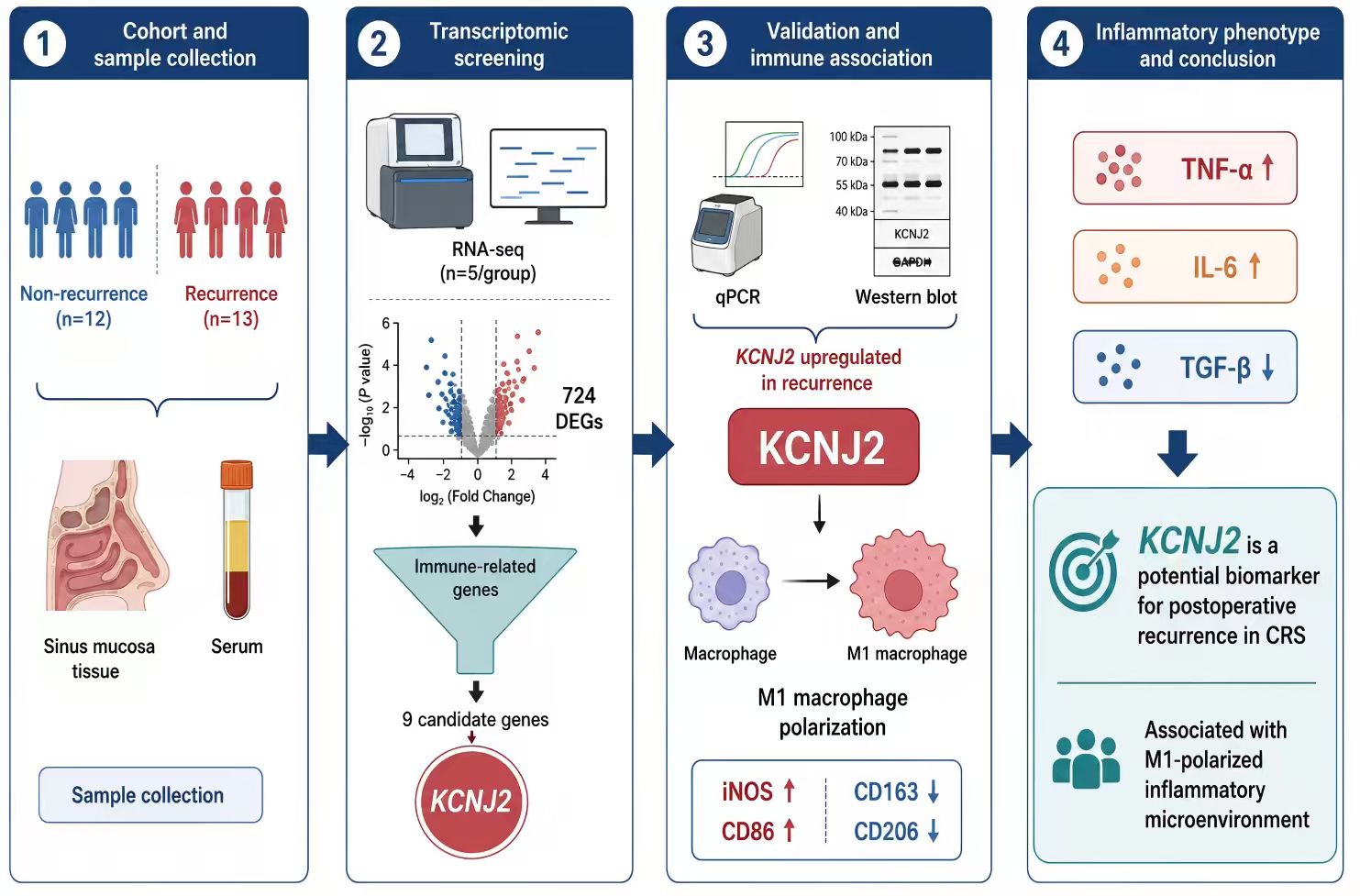
Chronic rhinosinusitis (CRS) is a prevalent inflammatory disease of the upper respiratory tract with a relatively high postoperative recurrence rate. Transcriptomic profiling may facilitate the identification of biomarkers associated with disease recurrence. This study aimed to characterize the transcriptomic features of postoperative recurrent CRS and identify potential recurrence-associated biomarkers. A total of 25 patients with CRS were enrolled, including 13 patients with postoperative recurrence and 12 without recurrence. Nasal mucosal tissues and serum samples were analyzed using RNA sequencing, RT-qPCR, Western blotting, and ELISA. KCNJ2 expression was significantly upregulated in the postoperative recurrence group. Immune infiltration analysis revealed a positive correlation between tissue KCNJ2 mRNA expression and estimated M1 macrophage infiltration. Further validation confirmed that KCNJ2 mRNA and protein levels were significantly increased in the recurrence group and positively correlated with M1 macrophage markers. In addition, serum cytokine levels were measured using ELISA. The serum levels of TNF-α and IL-6 were significantly increased in the postoperative recurrence group, whereas the serum level of TGF-β was significantly decreased compared with the non-recurrence group. These cytokine alterations were significantly correlated with tissue KCNJ2 expression. These findings suggest that elevated KCNJ2 expression is associated with postoperative recurrence and an M1-skewed inflammatory microenvironment in CRS. KCNJ2 may therefore represent a candidate recurrence-associated biomarker, although prospective validation is required.
References
[1] Orlandi RR, Kingdom TT, Smith TL, Bleier BS, DeConde AS, Luong AU, et al. International consensus statement on allergy and rhinology: rhinosinusitis 2021. International Forum of Allergy & Rhinology. 2021;11(3):213-739. https://doi.org/10.1002/alr.22741.
[2] Kato A, Peters AT, Stevens WW, Schleimer RP, Tan BK, Kern RC. Endotypes of chronic rhinosinusitis: relationships to disease phenotypes, pathogenesis, clinical findings, and treatment approaches. Allergy. 2022;77(3):812-826. https://doi.org/10.1111/all.15074.
[3] Almosnino G, Little RE. Surgical management of rhinosinusitis for the allergist-immunologist. Annals of Allergy, Asthma & Immunology. 2023;131(3):311-316. https://doi.org/10.1016/j.anai.2023.05.015.
[4] Maspero JF, Khan AH, Philpott C, Hellings PW, Hopkins C, Wagenmann M, et al. Health-related quality of life impairment among patients with severe chronic rhinosinusitis with nasal polyps in the SINUS-24 trial. Journal of Asthma and Allergy. 2023;16:323-332. https://doi.org/10.2147/JAA.S372598.
[5] Khalmuratova R, Park JW, Shin HW. Immune cell responses and mucosal barrier disruptions in chronic rhinosinusitis. Immune Network. 2017;17(1):60-67. https://doi.org/10.4110/in.2017.17.1.60.
[6] Kim JW, Hong SL, Kim YK, Lee CH, Min YG, Rhee CS. Histological and immunological features of non-eosinophilic nasal polyps. Otolaryngology-Head and Neck Surgery. 2007;137(6):925-930. https://doi.org/10.1016/j.otohns.2007.07.036.
[7] Shi JB, Fu QL, Zhang H, Cheng L, Wang YJ, Zhu DD, et al. Epidemiology of chronic rhinosinusitis: results from a cross-sectional survey in seven Chinese cities. Allergy. 2015;70(5):533-539. https://doi.org/10.1111/all.12577.
[8] Leopold DA, Elkayam D, Messina JC, Kosik-Gonzalez C, Djupesland PG, Mahmoud RA. NAVIGATE II: randomized, double-blind trial of the exhalation delivery system with fluticasone for nasal polyposis. Journal of Allergy and Clinical Immunology. 2019;143(1):126-134.e5. https://doi.org/10.1016/j.jaci.2018.06.010.
[9] Brzost J, Czerwaty K, Dżaman K, Ludwig N, Piszczatowska K, Szczepański MJ. Perspectives in therapy of chronic rhinosinusitis. Diagnostics. 2022;12(10):2301. https://doi.org/10.3390/diagnostics12102301.
[10] Grayson JW, Hopkins C, Mori E, Senior BA, Harvey RJ. Contemporary classification of chronic rhinosinusitis beyond polyps vs no polyps: a review. JAMA Otolaryngology-Head & Neck Surgery. 2020;146(9):831-838. https://doi.org/10.1001/jamaoto.2020.1453.
[11] Bouatay R, Bouaziz N, Abdelali M, Zrig A, El Korbi A, Ferjaoui M, et al. Endoscopic sinus surgery for chronic rhino sinusitis with nasal polyps: predictive factors of recurrence. Ear, Nose & Throat Journal. 2024;Online ahead of print:1455613241295494. https://doi.org/10.1177/01455613241295494.
[12] Liu X, Peng Y, Guo L, Xiong W, Liao W, Fan J. Unveiling and validating biomarkers related to the IL-10 family in chronic sinusitis with nasal polyps: insights from transcriptomics and single-cell RNA sequencing analysis. Frontiers in Molecular Biosciences. 2025;11:1513951. https://doi.org/10.3389/fmolb.2024.1513951.
[13] Wang Y, Song X, Jin M, Lu J. Characterization of the immune microenvironment and identification of biomarkers in chronic rhinosinusitis with nasal polyps using single-cell RNA sequencing and transcriptome analysis. Journal of Inflammation Research. 2024;17:253-277. https://doi.org/10.2147/JIR.S440409.
[14] Lv J, Jiang F. Integrative causal inference and predictive modeling reveal the iron-related gene SLC17A4 as a key biomarker in chronic rhinosinusitis. Frontiers in Immunology. 2026;16:1645726. https://doi.org/10.3389/fimmu.2025.1645726.
[15] Fan HL, Han ZT, Gong XR, Wu YQ, Fu YJ, Zhu TM, et al. Macrophages in CRSwNP: do they deserve more attention? International Immunopharmacology. 2024;134:112236. https://doi.org/10.1016/j.intimp.2024.112236.
[16] Jiang Z, Zhu L. Update on the role of alternatively activated macrophages in asthma. Journal of Asthma and Allergy. 2016;9:101-107. https://doi.org/10.2147/JAA.S104508.
[17] Tarique AA, Logan J, Thomas E, Holt PG, Sly PD, Fantino E. Phenotypic, functional, and plasticity features of classical and alternatively activated human macrophages. American Journal of Respiratory Cell and Molecular Biology. 2015;53(5):676-688. https://doi.org/10.1165/rcmb.2015-0012OC.
[18] Takabayashi T, Kato A, Peters AT, Hulse KE, Suh LA, Carter R, et al. Increased expression of factor XIII-A in patients with chronic rhinosinusitis with nasal polyps. Journal of Allergy and Clinical Immunology. 2013;132(3):584-592.e4. https://doi.org/10.1016/j.jaci.2013.02.003.
[19] Wang K, Yu J, Luo Q, Bai Y, Gao Q, Yu R. siHIF-1α-loaded micellar nanoparticles inhibit M1 macrophage activation to ameliorate chronic rhinosinusitis. Free Radical Biology and Medicine. 2025;237:403-418. https://doi.org/10.1016/j.freeradbiomed.2025.05.433.
[20] Kanehisa M, Furumichi M, Sato Y, Matsuura Y, Ishiguro-Watanabe M. KEGG: biological systems database as a model of the real world. Nucleic Acids Research. 2025;53(D1):D672-D677. https://doi.org/10.1093/nar/gkae909.
[21] Zhuang M, Jiao J, Zhang Q, Pan S, Zhang Y, He T, et al. Ruxolitinib, a novel JAK/STAT-targeted therapy through restoring mucosal homeostasis for chronic rhinosinusitis with nasal polyps. Journal of Allergy and Clinical Immunology. 2025;156(5):1219-1233. https://doi.org/10.1016/j.jaci.2025.07.020.
[22] Ayers CM, Schlosser RJ, O’Connell BP, Atkinson C, Mulligan RM, Casey SE, et al. Increased presence of dendritic cells and dendritic cell chemokines in the sinus mucosa of chronic rhinosinusitis with nasal polyps and allergic fungal rhinosinusitis. International Forum of Allergy & Rhinology. 2011;1(4):296-302. https://doi.org/10.1002/alr.20046.
[23] Klingler AI, Stevens WW, Tan BK, Peters AT, Poposki JA, Grammer LC, et al. Mechanisms and biomarkers of inflammatory endotypes in chronic rhinosinusitis without nasal polyps. Journal of Allergy and Clinical Immunology. 2021;147(4):1306-1317. https://doi.org/10.1016/j.jaci.2020.11.037.
[24] Hager NA, McAtee CK, Lesko MA, O’Donnell AF. Inwardly rectifying potassium channel Kir2.1 and its “Kir-ious” regulation by protein trafficking and roles in development and disease. Frontiers in Cell and Developmental Biology. 2022;9:796136. https://doi.org/10.3389/fcell.2021.796136.
[25] Ozekin YH, Isner T, Bates EA. Ion channel contributions to morphological development: insights from the role of Kir2.1 in bone development. Frontiers in Molecular Neuroscience. 2020;13:99. https://doi.org/10.3389/fnmol.2020.00099.
[26] Hansen SB, Tao X, MacKinnon R. Structural basis of PIP2 activation of the classical inward rectifier K+ channel Kir2.2. Nature. 2011;477(7365):495-498. https://doi.org/10.1038/nature10370.
[27] Backaert W, Steelant B, Hellings PW, Talavera K, Van Gerven L. A TRiP through the roles of transient receptor potential cation channels in type 2 upper airway inflammation. Current Allergy and Asthma Reports. 2021;21(3):20. https://doi.org/10.1007/s11882-020-00981-x.
[28] Deng Z, Zhao Y, Ma Z, Zhang M, Wang H, Yi Z, et al. Pathophysiological role of ion channels and transporters in gastrointestinal mucosal diseases. Cellular and Molecular Life Sciences. 2021;78(24):8109-8125. https://doi.org/10.1007/s00018-021-04011-5.
[29] Lin H, Zheng C, Li J, Yang C, Hu L. Lentiviral shRNA against KCa3.1 inhibits allergic response in allergic rhinitis and suppresses mast cell activity via the PI3K/AKT signaling pathway. Scientific Reports. 2015;5:13127. https://doi.org/10.1038/srep13127.
[30] Pelletier L, Savignac M. Involvement of ion channels in allergy. Current Opinion in Immunology. 2018;52:60-67. https://doi.org/10.1016/j.coi.2018.04.006.
[31] Vicente R, Escalada A, Coma M, Fuster G, Sánchez-Tilló E, López-Iglesias C, et al. Differential voltage-dependent K+ channel responses during proliferation and activation in macrophages. Journal of Biological Chemistry. 2003;278(47):46307-46320. https://doi.org/10.1074/jbc.M304388200.
[32] Qiao W, Wong KHM, Shen J, Wang W, Wu J, Li J, et al. TRPM7 kinase-mediated immunomodulation in macrophage plays a central role in magnesium ion-induced bone regeneration. Nature Communications. 2021;12(1):2885. https://doi.org/10.1038/s41467-021-23005-2.
[33] Yu W, Wang Z, Yu X, Zhao Y, Xie Z, Zhang K, et al. Kir2.1-mediated membrane potential promotes nutrient acquisition and inflammation through regulation of nutrient transporters. Nature Communications. 2022;13(1):3544. https://doi.org/10.1038/s41467-022-31149-y.
[34] Chen K, Man Q, Miao J, Xu W, Zheng Y, Zhou X, et al. Kir2.1 channel regulates macrophage polarization via the Ca2+/CaMKII/ERK/NF-κB signaling pathway. Journal of Cell Science. 2022;135(13):jcs259544. https://doi.org/10.1242/jcs.259544.
[35] Wang T, Chen Y, Gao R, Shui J, Xie B. Overexpression of AXL on macrophages associates with disease severity and recurrence in chronic rhinosinusitis with nasal polyps. International Immunopharmacology. 2023;121:110449. https://doi.org/10.1016/j.intimp.2023.110449.
[36] Zhong B, Du J, Liu F, Liu Y, Liu S, Zhang J, et al. Hypoxia-induced factor-1α induces NLRP3 expression by M1 macrophages in noneosinophilic chronic rhinosinusitis with nasal polyps. Allergy. 2021;76(2):582-586. https://doi.org/10.1111/all.14571.
[37] Bao X, Liu B, Jiang Y, Feng T, Cao W, Shi J, et al. Loss of SENP3 mediated the formation of nasal polyps in nasal mucosal inflammation by increasing alternatively activated macrophages. Immunity, Inflammation and Disease. 2023;11(2):e781. https://doi.org/10.1002/iid3.781.
[38] Dong Z, Jiang Y, Zhang J, Zheng C, Chen H, Tang W, et al. FERMT1 contributes to the epithelial-mesenchymal transition of chronic rhinosinusitis with nasal polyps via PI3K/Akt signaling. International Immunopharmacology. 2024;143(Pt 3):113545. https://doi.org/10.1016/j.intimp.2024.113545.
[39] Lin H, Lin D, Xiong XS, Dai XX, Lin T. Role of platelet-derived growth factor-α in eosinophilic and non-eosinophilic chronic rhinosinusitis with nasal polyps. International Forum of Allergy & Rhinology. 2014;4(11):909-914. https://doi.org/10.1002/alr.21419.
[40] Van Bruaene N, Derycke L, Perez-Novo CA, Gevaert P, Holtappels G, De Ruyck N, et al. TGF-β signaling and collagen deposition in chronic rhinosinusitis. Journal of Allergy and Clinical Immunology. 2009;124(2):253-259.e2. https://doi.org/10.1016/j.jaci.2009.04.013.
[41] Mantovani A, Biswas SK, Galdiero MR, Sica A, Locati M. Macrophage plasticity and polarization in tissue repair and remodelling. Journal of Pathology. 2013;229(2):176-185. https://doi.org/10.1002/path.4133.
Type
Published
Issue
Section
License
Copyright (c) 2026 Head and Neck Diseases Conflux

This work is licensed under a Creative Commons Attribution 4.0 International License.
How to Cite