Applications of Tumor Organoids in Head and Neck Diseases
DOI:
https://doi.org/10.71321/gmh71395Keywords:
Head and neck cancers, Patient-derived tumor organoids, Drug screening, Biomarker discovery, Regenerative medicineAbstract
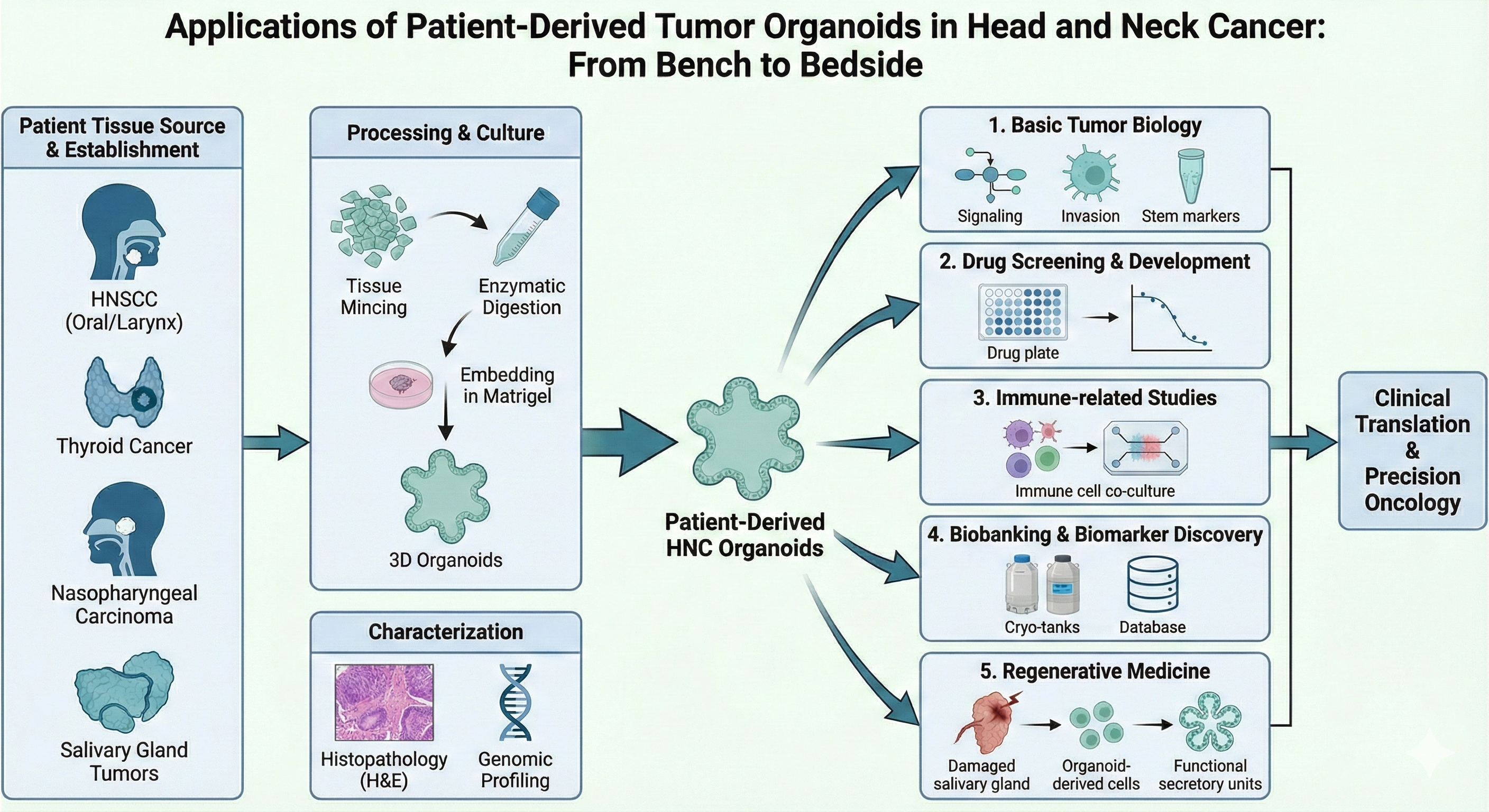
Head and neck cancers (HNC) constitute a highly heterogeneous group of malignancies with complex pathogenesis; effective clinical management remains challenging. Organoids, an emerging three-dimensional culture system, recapitulate key structural and functional features of the tissues of origin and offer distinctive advantages for studying head and neck cancer. Structured around four major head and neck cancer entities (head and neck squamous cell carcinoma, thyroid cancer, nasopharyngeal carcinoma, and malignant salivary gland tumors), this Review systematically outlines approaches for constructing head and neck cancer organoids, summarises common modelling methods and authentication strategies, and defines an integrated pipeline spanning acquisition, culture, validation and application. At the application level, we review five areas: basic tumor biology; drug screening and new drug development; immune-related studies; biobanking and biomarker discovery; and regenerative medicine with functional reconstruction. The goal is to inform subsequent research and clinical translation, and to highlight the broad prospects of this approach for addressing heterogeneity, therapy resistance and recurrence in head and neck cancer.
References
[1] Heinolainen A, Nguyen B, Silén S, Renkonen R, Koskinen M. Survival and data-driven phenotypes in head and neck cancer. Scientific Reports. 2025;15. https://doi.org/10.1038/s41598-025-89053-6
[2] Mody MD, Rocco JW, Yom SS, Haddad RI, Saba NF. Head and neck cancer. The Lancet. 2021;398:2289–99. https://doi.org/10.1016/s0140-6736(21)01550-6
[3] Buchberger DS, Campbell SR, Wu S, Lamarre E, Prendes B, Ku J, et al. Outcomes of Patients With Adenosquamous Carcinoma of the Head and Neck after Definitive Treatment. International Journal of Radiation Oncology • Biology • Physics. 2022;112:e22. https://doi.org/10.1016/j.ijrobp.2021.12.050
[4] Deb PQ. Adenosquamous carcinoma of the head and neck: epidemiological features and outcome analysis. American Journal of Clinical Pathology. 2022;158:S93–4. https://doi.org/10.1093/ajcp/aqac126.197
[5] Hoskins EL, Vella R, Reeser JW, Wing MR, Samorodnitsky E, Turkoglu A, et al. Prevalence and biological impact of clinically relevant gene fusions in head and neck cancers. npj Precision Oncology. 2025;9. https://doi.org/10.1038/s41698-025-00889-7
[6] Zhang G, Liang Q, Wu Y, Wang Y. Insights on the differences between two‑ and three‑dimensional culture systems in tumor models (Review). International Journal of Molecular Medicine. 2025;56:1–16. https://doi.org/10.3892/ijmm.2025.5626
[7] Invrea F, Rovito R, Torchiaro E, Petti C, Isella C, Medico E. Patient-derived xenografts (PDXs) as model systems for human cancer. Current Opinion in Biotechnology. 2020;63:151–6. https://doi.org/10.1016/j.copbio.2020.01.003
[8] Lee S-Y, Koo I-S, Hwang HJ, Lee DW. In Vitro Three-dimensional (3D) Cell Culture Tools for Spheroid and Organoid Models. SLAS Discovery: Advancing the Science of Drug Discovery. 2023;100131. https://doi.org/10.1016/j.slasd.2023.12.003
[9] Qi H, Tan X, Zhang W, Zhou Y, Chen S, Zha D, et al. The applications and techniques of organoids in head and neck cancer therapy. Front Oncol. 2023;13:1191614. https://doi.org/10.3389/fonc.2023.1191614
[10] Tong L, Cui W, Zhang B, Fonseca P, Zhao Q, Zhang P, et al. Patient-derived organoids in precision cancer medicine. Med. 2024;5:1351–77. https://doi.org/10.1016/j.medj.2024.08.010
[11] Millen R, De Kort WWB, Koomen M, van Son GJF, Gobits R, Penning de Vries B, et al. Patient-derived head and neck cancer organoids allow treatment stratification and serve as a tool for biomarker validation and identification. Med. 2023;4:290-310.e12. https://doi.org/10.1016/j.medj.2023.04.003
[12] Liu L, Yu L, Li Z, Li W, Huang W. Patient-derived organoid (PDO) platforms to facilitate clinical decision making. Journal of Translational Medicine. 2021;19. https://doi.org/10.1186/s12967-020-02677-2
[13] Brandi R, Palcau AC, Migliano E, Strano S, Blandino G. Patient-Derived Tumour Organoids (PDOs) may help oncologists in clinical practice. Personalized Medicine. 2025;1–8. https://doi.org/10.1080/17410541.2025.2581557
[14] Vlachogiannis G, Hedayat S, Vatsiou A, Jamin Y, Fernández-Mateos J, Khan K, et al. Patient-derived organoids model treatment response of metastatic gastrointestinal cancers. Science. 2018;359:920–6. https://doi.org/10.1126/science.aao2774
[15] Hwang M, Choe J, Shin YJ, Seo B-G, Park K-M, Shin SH, et al. Establishment of Human Lung Cancer Organoids Using Small Biopsy and Surgical Tissues. Cancers. 2025;17:2291. https://doi.org/10.3390/cancers17142291
[16] Li J, Chen Y, Zhang Y, Peng X, Wu M, Chen L, et al. Clinical value and influencing factors of establishing stomach cancer organoids by endoscopic biopsy. Journal of Cancer Research and Clinical Oncology. 2022;149:3803–10. https://doi.org/10.1007/s00432-022-04296-4
[17] Tanaka N, Osman AA, Takahashi Y, Lindemann A, Patel AA, Zhao M, et al. Head and neck cancer organoids established by modification of the CTOS method can be used to predict in vivo drug sensitivity. Oral Oncol. 2018;87:49–57. https://doi.org/10.1016/j.oraloncology.2018.10.018
[18] Wang X-W, Xia T-L, Tang H-C, Liu X, Han R, Zou X, et al. Establishment of a patient-derived organoid model and living biobank for nasopharyngeal carcinoma. Ann Transl Med. 2022;10:526. https://doi.org/10.21037/atm-22-1076
[19] Ogundipe VML, Groen AH, Hosper N, Nagle PWK, Hess J, Faber H, et al. Generation and Differentiation of Adult Tissue-Derived Human Thyroid Organoids. Stem Cell Reports. 2021;16:913–25. https://doi.org/10.1016/j.stemcr.2021.02.011
[20] Sabatini LM, Allen-Hoffmann BL, Warner TF, Azen EA. Serial cultivation of epithelial cells from human and macaque salivary glands. In Vitro Cell Dev Biol - Animal. 1991;27:939–48. https://doi.org/10.1007/BF02631121
[21] Meudec L, Goudarzi N, Silva-Saffar SE, Pascaud J, Jaulin F, Pascal Q, et al. Development of salivary gland organoids derived from patient biopsies: a functional model of Sjögren’s disease. Annals of the Rheumatic Diseases. Elsevier; 2025;84:1195–206. https://doi.org/10.1016/j.ard.2025.04.020
[22] Yoon Y-J, Kim D, Tak KY, Hwang S, Kim J, Sim NS, et al. Salivary gland organoid culture maintains distinct glandular properties of murine and human major salivary glands. Nature Communications. 2022;13. https://doi.org/10.1038/s41467-022-30934-z
[23] Kardia E, Frese M, Smertina E, Strive T, Zeng X-L, Estes M, et al. Culture and differentiation of rabbit intestinal organoids and organoid-derived cell monolayers. Scientific Reports. 2021;11. https://doi.org/10.1038/s41598-021-84774-w
[24] Ji Y, Sun Y. Advancements in Organoid Culture Technologies: Current Trends and Innovations. Stem Cells and Development. 2024;33:631–44. https://doi.org/10.1089/scd.2024.0132
[25] Viergever BJ, Raats DAE, Geurts V, Mullenders J, Jonges TN, van der Heijden MS, et al. Urine-derived bladder cancer organoids (urinoids) as a tool for cancer longitudinal response monitoring and therapy adaptation. Br J Cancer. 2024;130:369–79. https://doi.org/10.1038/s41416-023-02494-6
[26] Martin JH, Olver I. Precision medicine‐based drug treatment individualization in oncology. British Journal of Clinical Pharmacology. 2020;87:223–6. https://doi.org/10.1111/bcp.14512
[27] King V-CV, Tracy EC, Baumann H, Hershberger PA, Seshadri M. Abstract A22: Patient-derived organoids recapitulate response heterogeneity in head and neck cancer. Clinical Cancer Research. 2020;26:A22–A22. https://doi.org/10.1158/1557-3265.aacrahns19-a22
[28] Farshbaf A, Lotfi M, Zare R, Mohtasham N. The organoid as reliable cancer modeling in personalized medicine, does applicable in precision medicine of head and neck squamous cell carcinoma? The Pharmacogenomics Journal. 2022;23:37–44. https://doi.org/10.1038/s41397-022-00296-2
[29] Karakasheva TA, Kijima T, Shimonosono M, Maekawa H, Sahu V, Gabre JT, et al. Generation and Characterization of Patient-Derived Head and Neck, Oral, and Esophageal Cancer Organoids. Curr Protoc Stem Cell Biol. 2020;53:e109. https://doi.org/10.1002/cpsc.109
[30] Spence M, Cioffi I, Tomita Y, Flashner S, Martin C, Nakagawa H, et al. Protocol for single-cell dissociation of head and neck cancer organoids. STAR Protocols. 2025;6:103930. https://doi.org/10.1016/j.xpro.2025.103930
[31] Wan X, Liu Y, Peng Y, Wang J, Yan S, Zhang L, et al. Primary and Orthotopic Murine Models of Nasopharyngeal Carcinoma Reveal Molecular Mechanisms Underlying its Malignant Progression. Advanced Science. 2024;11:2403161. https://doi.org/10.1002/advs.202403161
[32] Lassche G, van Boxtel W, Aalders TW, van Hooij O, van Engen-van Grunsven ACH, Verhaegh GW, et al. Development and characterization of patient-derived salivary gland cancer organoid cultures. Oral Oncol. 2022;135:106186. https://doi.org/10.1016/j.oraloncology.2022.106186
[33] Aizawa Y, Takada K, Aoyama J, Sano D, Yamanaka S, Seki M, et al. Establishment of experimental salivary gland cancer models using organoid culture and patient-derived xenografting. Cell Oncol (Dordr). 2023;46:409–21. https://doi.org/10.1007/s13402-022-00758-6
[34] Lin K-C, Ting L-L, Chang C-L, Lu L-S, Lee H-L, Hsu F-C, et al. Ex Vivo Expanded Circulating Tumor Cells for Clinical Anti-Cancer Drug Prediction in Patients with Head and Neck Cancer. Cancers (Basel). 2021;13:6076. https://doi.org/10.3390/cancers13236076
[35] Marx V. Closing in on cancer heterogeneity with organoids. Nat Methods. Nature Publishing Group; 2024;21:551–4. https://doi.org/10.1038/s41592-024-02231-8
[36] Choi SY, Shim J, Gu D, Kim SY, Kim HJ, Shin D-Y, et al. Clonal evolution of long-term expanding head and neck cancer organoid: Impact on treatment response for personalized therapeutic screening. Oral Oncology. 2023;146:106571. https://doi.org/10.1016/j.oraloncology.2023.106571
[37] Fisch A-S, Pestana A, Sachse V, Doll C, Hofmann E, Heiland M, et al. Feasibility analysis of using patient-derived tumour organoids for treatment decision guidance in locally advanced head and neck squamous cell carcinoma. European Journal of Cancer [Internet]. Elsevier; 2024 [cited 2025 Nov 4];213. https://doi.org/10.1016/j.ejca.2024.115100
[38] Driehuis E, Kolders S, Spelier S, Lõhmussaar K, Willems SM, Devriese LA, et al. Oral Mucosal Organoids as a Potential Platform for Personalized Cancer Therapy. Cancer Discov. 2019;9:852–71. https://doi.org/10.1158/2159-8290.CD-18-1522
[39] Haughton PD, Haakma W, Chalkiadakis T, Breimer GE, Driehuis E, Clevers H, et al. Differential transcriptional invasion signatures from patient derived organoid models define a functional prognostic tool for head and neck cancer. Oncogene. 2024;43:2463–74. https://doi.org/10.1038/s41388-024-03091-4
[40] Jin H, Xue Z, Liu J, Ma B, Yang J, Lei L. Advancing Organoid Engineering for Tissue Regeneration and Biofunctional Reconstruction. Biomaterials Research. American Association for the Advancement of Science; 2024;28:0016. https://doi.org/10.34133/bmr.0016
[41] Weeber F, Ooft SN, Dijkstra KK, Voest EE. Tumor Organoids as a Pre-clinical Cancer Model for Drug Discovery. Cell Chem Biol. 2017;24:1092–100. https://doi.org/10.1016/j.chembiol.2017.06.012
[42] Fujii M, Matano M, Nanki K, Sato T. Efficient genetic engineering of human intestinal organoids using electroporation. Nat Protoc. 2015;10:1474–85. https://doi.org/10.1038/nprot.2015.088
[43] Vistoso Monreal A, Zhao H, Sedghizadeh PP, Lin D-C. Patient-derived tumor organoids to model drug response in gastric cancer. Cell Reports Medicine. 2024;5:101650. https://doi.org/10.1016/j.xcrm.2024.101650
[44] Whelan KA, Muir AB, Nakagawa H. Esophageal 3D Culture Systems as Modeling Tools in Esophageal Epithelial Pathobiology and Personalized Medicine. Cell Mol Gastroenterol Hepatol. 2018;5:461–78. https://doi.org/10.1016/j.jcmgh.2018.01.011
[45] Zhao H, Hu C, Chen W, Huang P. Lactate Promotes Cancer Stem-like Property of Oral Sequamous Cell Carcinoma. Current Medical Science. 2019;39:403–9. https://doi.org/10.1007/s11596-019-2050-2
[46] Sekhar KR, Codreanu SG, Williams OC, Rathmell JC, Rathmell WK, McLean JA, et al. Metabolism of parathyroid organoids. Frontiers in Endocrinology. 2023;14. https://doi.org/10.3389/fendo.2023.1223312
[47] Yoo MH, Kim Y, Lee B-S. Thyroid cancer risk associated with perfluoroalkyl carboxylate exposure: Assessment using a human dermal fibroblast–derived extracellular matrix–based thyroid cancer organoid. Journal of Hazardous Materials. 2024;479:135771. https://doi.org/10.1016/j.jhazmat.2024.135771
[48] Shimonosono M, Tanaka K, Flashner S, Takada S, Matsuura N, Tomita Y, et al. Alcohol Metabolism Enriches Squamous Cell Carcinoma Cancer Stem Cells That Survive Oxidative Stress via Autophagy. Biomolecules. 2021;11:1479. https://doi.org/10.3390/biom11101479
[49] Liu Z-L, Chen H-H, Zheng L-L, Sun L-P, Shi L. Angiogenic signaling pathways and anti-angiogenic therapy for cancer. Sig Transduct Target Ther. Nature Publishing Group; 2023;8:198. https://doi.org/10.1038/s41392-023-01460-1
[50] Chaves P, Garrido M, Oliver J, Pérez-Ruiz E, Barragan I, Rueda-Domínguez A. Preclinical models in head and neck squamous cell carcinoma. Br J Cancer. Nature Publishing Group; 2023;128:1819–27. https://doi.org/10.1038/s41416-023-02186-1
[51] Liu S, Zhang W, Liu W, Ding Z, Zhang R, Han Y, et al. PRMT1-Mediated SWI/SNF Complex Recruitment via SMARCC1 Drives IGF2BP2 Transcription to Enhance Carboplatin Resistance in Head and Neck Squamous Cell Carcinoma. Adv Sci (Weinh). 2025;12:e2417460. https://doi.org/10.1002/advs.202417460
[52] Driehuis E, Spelier S, Beltrán Hernández I, de Bree R, M Willems S, Clevers H, et al. Patient-Derived Head and Neck Cancer Organoids Recapitulate EGFR Expression Levels of Respective Tissues and Are Responsive to EGFR-Targeted Photodynamic Therapy. J Clin Med. 2019;8:1880. https://doi.org/10.3390/jcm8111880
[53] Chenchula S, Kumar S, Babu S. Comparative Efficacy of 3Dimensional (3D) Cell Culture Organoids Vs 2Dimensional (2D) Cell Cultures Vs Experimental Animal Models In Disease modeling, Drug development, And Drug Toxicity Testing. International Journal of Current Research and Review. 2019;11:11–7. https://doi.org/10.31782/ijcrr.2019.11242
[54] Shah AT, Heaster TM, Skala MC. Metabolic Imaging of Head and Neck Cancer Organoids. PLoS One. 2017;12:e0170415. https://doi.org/10.1371/journal.pone.0170415
[55] Pauli C, Hopkins BD, Prandi D, Shaw R, Fedrizzi T, Sboner A, et al. Personalized In Vitro and In Vivo Cancer Models to Guide Precision Medicine. Cancer Discov. 2017;7:462–77. https://doi.org/10.1158/2159-8290.CD-16-1154
[56] Yao Y, Xu X, Yang L, Zhu J, Wan J, Shen L, et al. Patient-Derived Organoids Predict Chemoradiation Responses of Locally Advanced Rectal Cancer. Cell Stem Cell. 2020;26:17-26.e6. https://doi.org/10.1016/j.stem.2019.10.010
[57] National Library of Medicine - National Institutes of Health [Internet]. U.S. National Library of Medicine; [cited 2025 Nov 4]. https://www.nlm.nih.gov/. Accessed 4 Nov 2025
[58] Wang H-C, Chan L-P, Cho S-F. Targeting the Immune Microenvironment in the Treatment of Head and Neck Squamous Cell Carcinoma. Front Oncol. 2019;9:1084. https://doi.org/10.3389/fonc.2019.01084
[59] Feng B, Hess J. Immune-Related Mutational Landscape and Gene Signatures: Prognostic Value and Therapeutic Impact for Head and Neck Cancer. Cancers (Basel). 2021;13:1162. https://doi.org/10.3390/cancers13051162
[60] O’Brien LL. Enhancing kidney organoid maturity with inducible vascularization: another step forward for in vitro modeling. Kidney International. Elsevier; 2024;106:1017–20. https://doi.org/10.1016/j.kint.2024.09.013
[61] Palmer WH, Norman PJ. The impact of HLA polymorphism on herpesvirus infection and disease. Immunogenetics. 2023;75:231–47. https://doi.org/10.1007/s00251-022-01288-z
[62] Soussi FEA, Brusilovsky M, Buck E, Bacon WC, Dadgar S, Fullerton A, et al. Autologous Organoid-T Cell Co-Culture Platform for Modeling of Immune-Mediated Drug-Induced Liver Injury. Advanced Science. 2025;12. https://doi.org/10.1002/advs.202508584
[63] Cattaneo CM, Dijkstra KK, Fanchi LF, Kelderman S, Kaing S, van Rooij N, et al. Tumor organoid-T-cell coculture systems. Nat Protoc. 2020;15:15–39. https://doi.org/10.1038/s41596-019-0232-9
[64] Yuki K, Cheng N, Nakano M, Kuo CJ. Organoid Models of Tumor Immunology. Trends in Immunology. 2020;41:652–64. https://doi.org/10.1016/j.it.2020.06.010
[65] Al-Samadi A, Poor B, Tuomainen K, Liu V, Hyytiäinen A, Suleymanova I, et al. In vitro humanized 3D microfluidic chip for testing personalized immunotherapeutics for head and neck cancer patients. Experimental Cell Research. 2019;383:111508. https://doi.org/10.1016/j.yexcr.2019.111508
[66] Neal JT, Li X, Zhu J, Giangarra V, Grzeskowiak CL, Ju J, et al. Organoid Modeling of the Tumor Immune Microenvironment. Cell. 2018;175:1972-1988.e16. https://doi.org/10.1016/j.cell.2018.11.021
[67] Gu Z, Wu Q, Shang B, Zhang K, Zhang W. Organoid co-culture models of the tumor microenvironment promote precision medicine. Cancer Innov. 2024;3:e101. https://doi.org/10.1002/cai2.101
[68] Issing C, Menche C, Richter MR, Mosa MH, von der Grün J, Fleischmann M, et al. Head and neck tumor organoid biobank for modelling individual responses to radiation therapy according to the TP53/HPV status. J Exp Clin Cancer Res. 2025;44:85. https://doi.org/10.1186/s13046-025-03345-3
[69] Wang B, Gan J, Liu Z, Hui Z, Wei J, Gu X, et al. An organoid library of salivary gland tumors reveals subtype-specific characteristics and biomarkers. J Exp Clin Cancer Res. 2022;41:350. https://doi.org/10.1186/s13046-022-02561-5
[70] Aalam SMM, Varela AR, Khaderi A, Mondesir RJ, Mun D-G, Ding A, et al. The Mayo Clinic Salivary Tissue-Organoid Biobanking: A Resource for Salivary Regeneration Research. bioRxiv. 2024;2024.02.23.581761. https://doi.org/10.1101/2024.02.23.581761
[71] Meng R, Yu L, Li X, Ning N, Hao H, Zhang X, et al. Head and neck cancer organoids: a panoramic perspective from basic construction to clinical translation. Stem Cell Research & Therapy. 2025;16:534. https://doi.org/10.1186/s13287-025-04599-6
[72] Zhou C, Wu Y, Wang Z, Liu Y, Yu J, Wang W, et al. Standardization of organoid culture in cancer research. Cancer Medicine. 2023;12:14375–86. https://doi.org/10.1002/cam4.5943
[73] Lin C-Y, Ju S-S, Chia J-S, Chang C-H, Chang C-W, Chen M-H. Effects of radiotherapy on salivary gland function in patients with head and neck cancers. Journal of Dental Sciences. 2015;10:253–62. https://doi.org/10.1016/j.jds.2015.01.004
[74] Bücheler M, Wirz C, Schütz A, Bootz F. Tissue Engineering of Human Salivary Gland Organoids. Acta Oto-Laryngologica. 2002;122:541–5. https://doi.org/10.1080/00016480260092372
[75] Ozdemir T, Srinivasan PP, Zakheim DR, Harrington DA, Witt RL, Farach-Carson MC, et al. Bottom-up assembly of salivary gland microtissues for assessing myoepithelial cell function. Biomaterials. 2017;142:124–35. https://doi.org/10.1016/j.biomaterials.2017.07.022
[76] Klangprapan J, Souza GR, Ferreira JN. Bioprinting salivary gland models and their regenerative applications. BDJ Open. Nature Publishing Group; 2024;10:39. https://doi.org/10.1038/s41405-024-00219-2
Type
Published
Issue
Section
License
Copyright (c) 2025 Head and Neck Diseases Conflux

This work is licensed under a Creative Commons Attribution 4.0 International License.
How to Cite