Neuromodulation and Electrophysiological Monitoring in Headache Management: Current Advances and Future Perspectives
DOI:
https://doi.org/10.71321/vah93v44Keywords:
headache, neuromodulation, electrophysiological monitoring, neuroimagingAbstract
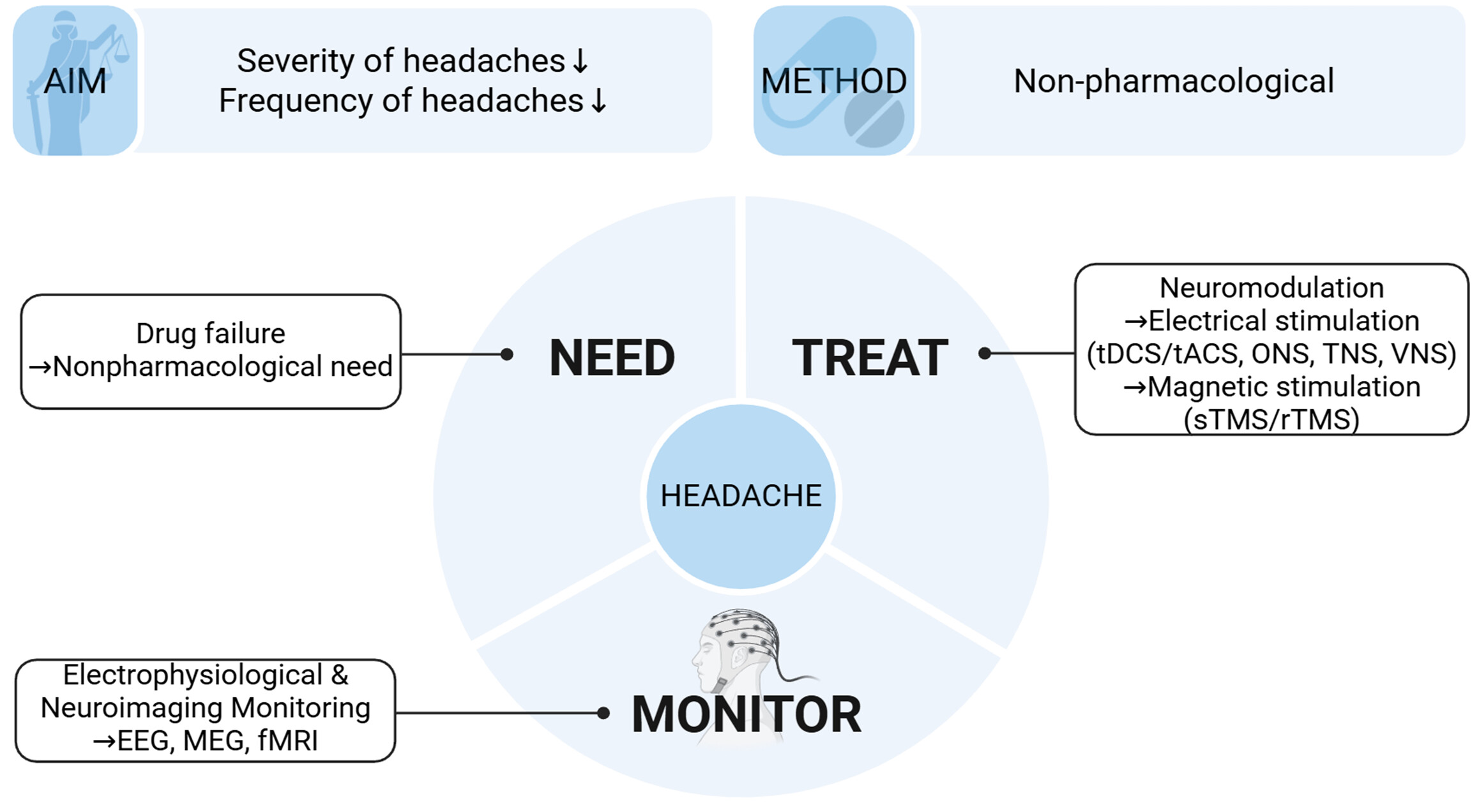
Headache disorders such as migraine are major causes of disability worldwide. Pharmacological treatments are often insufficient, particularly in resistant or refractory cases. Neuromodulation techniques, including transcranial magnetic stimulation (TMS), transcranial direct current stimulation (tDCS), transcranial alternating current stimulation (tACS), and peripheral approaches such as occipital nerve stimulation (ONS), trigeminal nerve stimulation (TNS), sphenopalatine ganglion (SPG) stimulation, and non-invasive vagus nerve stimulation (nVNS), offer promising alternatives. Electrophysiological methods including electroencephalography (EEG), magnetoencephalography (MEG), evoked potentials, and TMS combined with EEG (TMS-EEG) provide mechanistic insights and potential biomarkers for treatment monitoring and personalization. Here, we summarize emerging findings on neuromodulation and electrophysiological biomarkers in headache disorders, highlight their mechanistic underpinnings, and propose future directions for optimizing individualized treatment strategies. Key challenges remain, including small sample sizes, heterogeneous stimulation protocols, and limited long-term data. Future research should prioritize multicenter randomized controlled trial (RCT), closed-loop neuromodulation, and multimodal integration to advance precision headache medicine.
References
[1] Global incidence, prevalence, years lived with disability (YLDs), disability-adjusted life-years (DALYs), and healthy life expectancy (HALE) for 371 diseases and injuries in 204 countries and territories and 811 subnational locations, 1990-2021: a systematic analysis for the Global Burden of Disease Study 2021. (2024). Lancet, 403(10440), 2133-2161. https://doi.org/10.1016/s0140-6736(24)00757-8
[2] Bentivegna E, Galastri S, Onan D, & Martelletti P. (2024). Unmet Needs in the Acute Treatment of Migraine. Adv Ther, 41(1), 1-13. https://doi.org/10.1007/s12325-023-02650-7
[3] Ornello R, Andreou AP, De Matteis E, Jürgens TP, Minen MT, & Sacco S. (2024). Resistant and refractory migraine: clinical presentation, pathophysiology, and management. EBioMedicine, 99, 104943. https://doi.org/10.1016/j.ebiom.2023.104943
[4] Puledda F, & Goadsby PJ. (2016). Current Approaches to Neuromodulation in Primary Headaches: Focus on Vagal Nerve and Sphenopalatine Ganglion Stimulation. Curr Pain Headache Rep, 20(7), 47. https://doi.org/10.1007/s11916-016-0577-5
[5] Bohotin V, Fumal A, Vandenheede M, Gérard P, Bohotin C, Maertens de Noordhout A, et al. (2002). Effects of repetitive transcranial magnetic stimulation on visual evoked potentials in migraine. Brain, 125(Pt 4), 912-922. https://doi.org/10.1093/brain/awf081
[6] Kalita J, Bhoi SK, & Misra UK. (2017). Effect of high rate rTMS on somatosensory evoked potential in migraine. Cephalalgia, 37(13), 1222-1230. https://doi.org/10.1177/0333102416675619
[7] Coppola G, De Pasqua V, Pierelli F, & Schoenen J. (2012). Effects of repetitive transcranial magnetic stimulation on somatosensory evoked potentials and high frequency oscillations in migraine. Cephalalgia, 32(9), 700-709. https://doi.org/10.1177/0333102412446313
[8] Cirillo G, Pepe R, Siciliano M, Ippolito D, Ricciardi D, de Stefano M, et al. (2023). Long-Term Neuromodulatory Effects of Repetitive Transcranial Magnetic Stimulation (rTMS) on Plasmatic Matrix Metalloproteinases (MMPs) Levels and Visuospatial Abilities in Mild Cognitive Impairment (MCI). Int J Mol Sci, 24(4). https://doi.org/10.3390/ijms24043231
[9] Yang Y, Han Y, Wang J, Zhou Y, Chen D, Wang M, et al. (2023). Effects of altered excitation-inhibition imbalance by repetitive transcranial magnetic stimulation for self-limited epilepsy with centrotemporal spikes. Front Neurol, 14, 1164082. https://doi.org/10.3389/fneur.2023.1164082
[10] Tian D, & Izumi SI. (2022). Interhemispheric Facilitatory Effect of High-Frequency rTMS: Perspective from Intracortical Facilitation and Inhibition. Brain Sci, 12(8). https://doi.org/10.3390/brainsci12080970
[11] McClintock SM, Reti IM, Carpenter LL, McDonald WM, Dubin M, Taylor SF, et al. (2018). Consensus Recommendations for the Clinical Application of Repetitive Transcranial Magnetic Stimulation (rTMS) in the Treatment of Depression. J Clin Psychiatry, 79(1). https://doi.org/10.4088/JCP.16cs10905
[12] Lipton RB, Dodick DW, Silberstein SD, Saper JR, Aurora SK, Pearlman SH, et al. (2010). Single-pulse transcranial magnetic stimulation for acute treatment of migraine with aura: a randomised, double-blind, parallel-group, sham-controlled trial. Lancet Neurol, 9(4), 373-380. https://doi.org/10.1016/s1474-4422(10)70054-5
[13] Kalita J, Laskar S, Bhoi SK, & Misra UK. (2016). Efficacy of single versus three sessions of high rate repetitive transcranial magnetic stimulation in chronic migraine and tension-type headache. J Neurol, 263(11), 2238-2246. https://doi.org/10.1007/s00415-016-8257-2
[14] Sahu AK, Sinha VK, & Goyal N. (2019). Effect of adjunctive intermittent theta-burst repetitive transcranial magnetic stimulation as a prophylactic treatment in migraine patients: A double-blind sham-controlled study. Indian J Psychiatry, 61(2), 139-145. https://doi.org/10.4103/psychiatry.IndianJPsychiatry_472_18
[15] Portocarrero-Sánchez L, Rizea C, Díez-Tejedor E, León-Ruiz M, & Díaz-de-Terán J. (2025). Evaluating Repetitive Transcranial Magnetic Stimulation for Refractory Chronic Cluster Headache Prevention: Insights from a Randomized Crossover Pilot Trial. Brain Sci, 15(6). https://doi.org/10.3390/brainsci15060554
[16] Aurora SK, Ahmad BK, Welch KM, Bhardhwaj P, & Ramadan NM. (1998). Transcranial magnetic stimulation confirms hyperexcitability of occipital cortex in migraine. Neurology, 50(4), 1111-1114. https://doi.org/10.1212/wnl.50.4.1111
[17] Gerwig M, Niehaus L, Kastrup O, Stude P, & Diener HC. (2005). Visual cortex excitability in migraine evaluated by single and paired magnetic stimuli. Headache, 45(10), 1394-1399. https://doi.org/10.1111/j.1526-4610.2005.00272.x
[18] Brighina F, Piazza A, Daniele O, & Fierro B. (2002). Modulation of visual cortical excitability in migraine with aura: effects of 1 Hz repetitive transcranial magnetic stimulation. Exp Brain Res, 145(2), 177-181. https://doi.org/10.1007/s00221-002-1096-7
[19] Puledda F, Viganò A, Sebastianelli G, Parisi V, Hsiao FJ, Wang SJ, et al. (2023). Electrophysiological findings in migraine may reflect abnormal synaptic plasticity mechanisms: A narrative review. Cephalalgia, 43(8), 3331024231195780. https://doi.org/10.1177/03331024231195780
[20] Dai W, Qiu E, Lin X, Zhang S, Zhang M, Han X, et al. (2023). Abnormal Thalamo-Cortical Interactions in Overlapping Communities of Migraine: An Edge Functional Connectivity Study. Ann Neurol, 94(6), 1168-1181. https://doi.org/10.1002/ana.26783
[21] Hong P, Liu Y, Wan Y, Xiong H, & Xu Y. (2022). Transcranial direct current stimulation for migraine: a systematic review and meta-analysis of randomized controlled trials. CNS Neurosci Ther, 28(7), 992-998. https://doi.org/10.1111/cns.13843
[22] Andrade SM, de Brito Aranha REL, de Oliveira EA, de Mendonça C, Martins WKN, Alves NT, et al. (2017). Transcranial direct current stimulation over the primary motor vs prefrontal cortex in refractory chronic migraine: A pilot randomized controlled trial. J Neurol Sci, 378, 225-232. https://doi.org/10.1016/j.jns.2017.05.007
[23] Rocha S, Rodrigues MCA, Mendonça MB, Nogueira F, Boudoux C, Melo L, et al. (2021). Could cathodal transcranial direct current stimulation modulate the power spectral density of alpha-band in migrainous occipital lobe? Neurosci Lett, 742, 135539. https://doi.org/10.1016/j.neulet.2020.135539
[24] De Icco R, Putortì A, De Paoli I, Ferrara E, Cremascoli R, Terzaghi M, et al. (2021). Anodal transcranial direct current stimulation in chronic migraine and medication overuse headache: A pilot double-blind randomized sham-controlled trial. Clin Neurophysiol, 132(1), 126-136. https://doi.org/10.1016/j.clinph.2020.10.014
[25] Antal A, Bischoff R, Stephani C, Czesnik D, Klinker F, Timäus C, et al. (2020). Low Intensity, Transcranial, Alternating Current Stimulation Reduces Migraine Attack Burden in a Home Application Set-Up: A Double-Blinded, Randomized Feasibility Study. Brain Sci, 10(11). https://doi.org/10.3390/brainsci10110888
[26] Vyas DB, Ho AL, Dadey DY, Pendharkar AV, Sussman ES, Cowan R, et al. (2019). Deep Brain Stimulation for Chronic Cluster Headache: A Review. Neuromodulation, 22(4), 388-397. https://doi.org/10.1111/ner.12869
[27] Krause B, Márquez-Ruiz J, & Cohen Kadosh R. (2013). The effect of transcranial direct current stimulation: a role for cortical excitation/inhibition balance? Front Hum Neurosci, 7, 602. https://doi.org/10.3389/fnhum.2013.00602
[28] Berger A, Pixa NH, Steinberg F, & Doppelmayr M. (2018). Brain Oscillatory and Hemodynamic Activity in a Bimanual Coordination Task Following Transcranial Alternating Current Stimulation (tACS): A Combined EEG-fNIRS Study. Front Behav Neurosci, 12, 67. https://doi.org/10.3389/fnbeh.2018.00067
[29] Ashkan K, Sokratous G, Göbel H, Mehta V, Gendolla A, Dowson A, et al. (2020). Peripheral nerve stimulation registry for intractable migraine headache (RELIEF): a real-life perspective on the utility of occipital nerve stimulation for chronic migraine. Acta Neurochir (Wien), 162(12), 3201-3211. https://doi.org/10.1007/s00701-020-04372-z
[30] Liu Y, Dong Z, Wang R, Ao R, Han X, Tang W, et al. (2017). Migraine Prevention Using Different Frequencies of Transcutaneous Occipital Nerve Stimulation: A Randomized Controlled Trial. J Pain, 18(8), 1006-1015. https://doi.org/10.1016/j.jpain.2017.03.012
[31] Miller S, Watkins L, & Matharu M. (2016). Long-term outcomes of occipital nerve stimulation for chronic migraine: a cohort of 53 patients. J Headache Pain, 17(1), 68. https://doi.org/10.1186/s10194-016-0659-0
[32] Matharu MS, Bartsch T, Ward N, Frackowiak RS, Weiner R, & Goadsby PJ. (2004). Central neuromodulation in chronic migraine patients with suboccipital stimulators: a PET study. Brain, 127(Pt 1), 220-230. https://doi.org/10.1093/brain/awh022
[33] Magis D, Sava S, d'Elia TS, Baschi R, & Schoenen J. (2013). Safety and patients' satisfaction of transcutaneous supraorbital neurostimulation (tSNS) with the Cefaly® device in headache treatment: a survey of 2,313 headache sufferers in the general population. J Headache Pain, 14(1), 95. https://doi.org/10.1186/1129-2377-14-95
[34] Schoenen J, Vandersmissen B, Jeangette S, Herroelen L, Vandenheede M, Gérard P, et al. (2013). Migraine prevention with a supraorbital transcutaneous stimulator: a randomized controlled trial. Neurology, 80(8), 697-704. https://doi.org/10.1212/WNL.0b013e3182825055
[35] Schoenen J, Jensen RH, Lantéri-Minet M, Láinez MJ, Gaul C, Goodman AM, et al. (2013). Stimulation of the sphenopalatine ganglion (SPG) for cluster headache treatment. Pathway CH-1: a randomized, sham-controlled study. Cephalalgia, 33(10), 816-830. https://doi.org/10.1177/0333102412473667
[36] Silberstein SD, Calhoun AH, Lipton RB, Grosberg BM, Cady RK, Dorlas S, et al. (2016). Chronic migraine headache prevention with noninvasive vagus nerve stimulation: The EVENT study. Neurology, 87(5), 529-538. https://doi.org/10.1212/wnl.0000000000002918
[37] Silberstein SD, Mechtler LL, Kudrow DB, Calhoun AH, McClure C, Saper JR, et al. (2016). Non-Invasive Vagus Nerve Stimulation for the ACute Treatment of Cluster Headache: Findings From the Randomized, Double-Blind, Sham-Controlled ACT1 Study. Headache, 56(8), 1317-1332. https://doi.org/10.1111/head.12896
[38] Goadsby PJ, de Coo IF, Silver N, Tyagi A, Ahmed F, Gaul C, et al. (2018). Non-invasive vagus nerve stimulation for the acute treatment of episodic and chronic cluster headache: A randomized, double-blind, sham-controlled ACT2 study. Cephalalgia, 38(5), 959-969. https://doi.org/10.1177/0333102417744362
[39] Tassorelli C, Grazzi L, de Tommaso M, Pierangeli G, Martelletti P, Rainero I, et al. (2018). Noninvasive vagus nerve stimulation as acute therapy for migraine: The randomized PRESTO study. Neurology, 91(4), e364-e373. https://doi.org/10.1212/wnl.0000000000005857
[40] Gaul C, Diener HC, Silver N, Magis D, Reuter U, Andersson A, et al. (2016). Non-invasive vagus nerve stimulation for PREVention and Acute treatment of chronic cluster headache (PREVA): A randomised controlled study. Cephalalgia, 36(6), 534-546. https://doi.org/10.1177/0333102415607070
[41] Tu Y, Fu Z, Zeng F, Maleki N, Lan L, Li Z, et al. (2019). Abnormal thalamocortical network dynamics in migraine. Neurology, 92(23), e2706-e2716. https://doi.org/10.1212/wnl.0000000000007607
[42] Gomez-Pilar J, Martínez-Cagigal V, García-Azorín D, Gómez C, Guerrero Á, & Hornero R. (2022). Headache-related circuits and high frequencies evaluated by EEG, MRI, PET as potential biomarkers to differentiate chronic and episodic migraine: Evidence from a systematic review. J Headache Pain, 23(1), 95. https://doi.org/10.1186/s10194-022-01465-1
[43] Morris RG. (1999). D.O. Hebb: The Organization of Behavior, Wiley: New York; 1949. Brain Res Bull, 50(5-6), 437. https://doi.org/10.1016/s0361-9230(99)00182-3
[44] Pierelli F, Iacovelli E, Bracaglia M, Serrao M, & Coppola G. (2013). Abnormal sensorimotor plasticity in migraine without aura patients. Pain, 154(9), 1738-1742. https://doi.org/10.1016/j.pain.2013.05.023
[45] Alaydin HC, Vuralli D, Keceli Y, Can E, Cengiz B, & Bolay H. (2019). Reduced Short-Latency Afferent Inhibition Indicates Impaired Sensorimotor Integrity During Migraine Attacks. Headache, 59(6), 906-914. https://doi.org/10.1111/head.13554
[46] Coppola G, Cortese F, Bracaglia M, Di Lorenzo C, Serrao M, Magis D, et al. (2020). The function of the lateral inhibitory mechanisms in the somatosensory cortex is normal in patients with chronic migraine. Clin Neurophysiol, 131(4), 880-886. https://doi.org/10.1016/j.clinph.2020.01.009
[47] Zhou S, Hussain N, Abd-Elsayed A, Boulos R, Hakim M, Gupta M, et al. (2021). Peripheral Nerve Stimulation for Treatment of Headaches: An Evidence-Based Review. Biomedicines, 9(11). https://doi.org/10.3390/biomedicines9111588
Type
Published
Data Availability Statement
All data needed to evaluate the conclusions in the paper are present in the paper. Additional data related to this paper may be requested from the authors.
Issue
Section
License
Copyright (c) 2026 Brain Conflux

This work is licensed under a Creative Commons Attribution 4.0 International License.
How to Cite