Multilayered Regulation of SLC7A11 in Cancer: From Expression Control to Functional Ferroptosis Adaptation
DOI:
https://doi.org/10.71321/1pnycg20Keywords:
SLC7A11, xCT, system xc−, ferroptosis, cystine transport, glutathione, RNA modification, ubiquitination, cancer therapyAbstract
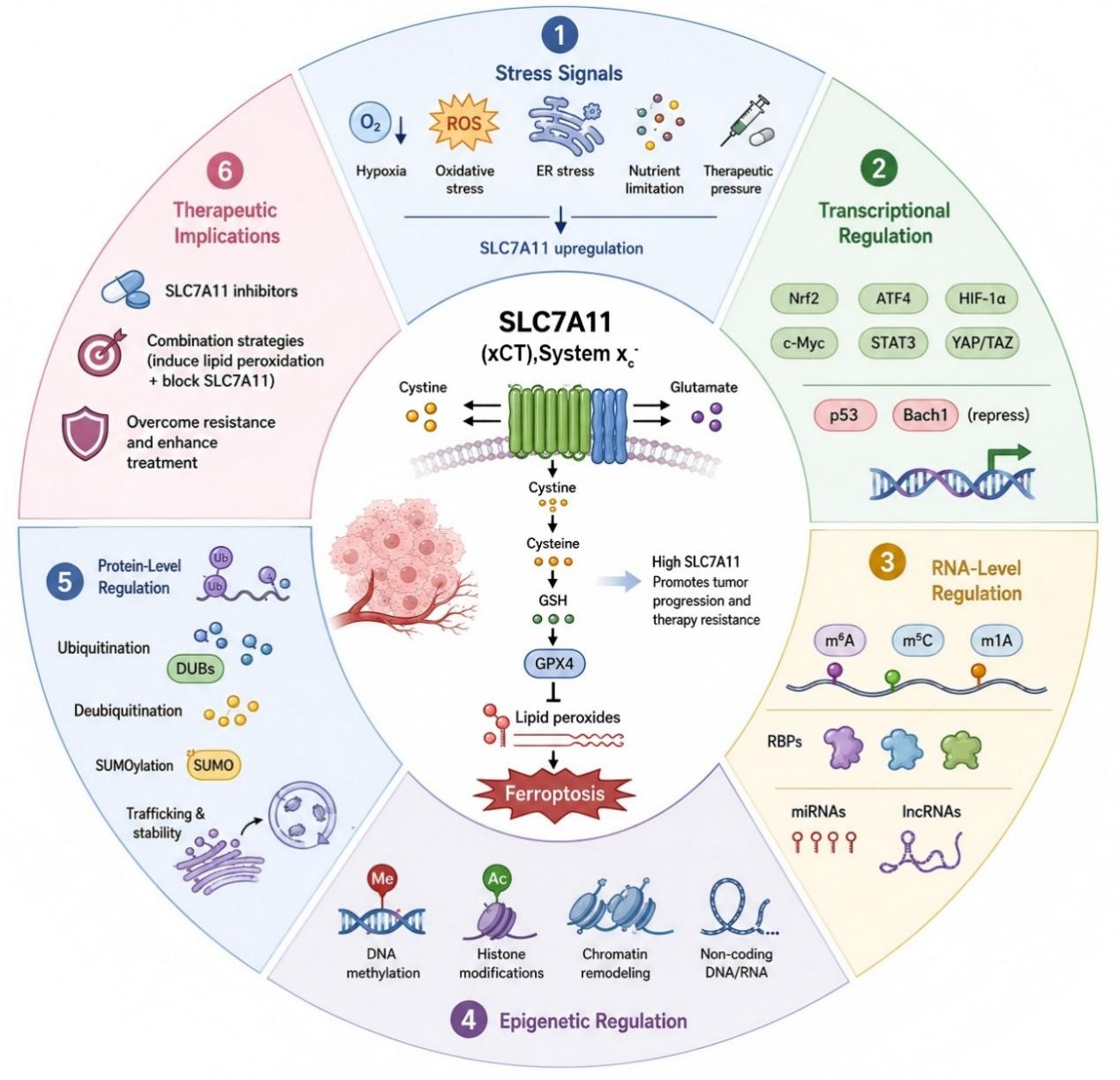
SLC7A11, also known as xCT, is the functional light-chain subunit of system xc− and mediates extracellular cystine uptake in exchange for intracellular glutamate. By supplying cystine for glutathione (GSH) biosynthesis and sustaining glutathione peroxidase 4 (GPX4)-dependent detoxification of lipid peroxides, SLC7A11 occupies a central position in ferroptosis control. In cancer, SLC7A11 is not merely an amino acid transporter, but a stress-adaptive hub through which tumor cells convert hypoxia, oxidative stress, endoplasmic reticulum stress, nutrient limitation, and therapeutic pressure into antioxidant defense and ferroptosis resistance. This review summarizes the multilayered regulation of SLC7A11 expression in cancer. We first introduce the structural and functional basis of SLC7A11 and its biological significance in ferroptosis and tumor progression. We then discuss its epigenetic regulation, transcriptional regulatory network, post-transcriptional and translational control-including RNA modifications, RNA-binding proteins, and non-coding RNA networks-and protein homeostasis and post-translational regulation. Finally, we highlight therapeutic strategies centered on SLC7A11 and propose that effective ferroptosis-based cancer therapy may require simultaneous induction of lipid peroxidation stress and blockade of adaptive SLC7A11 upregulation or stabilization.
References
Sato, H, M Tamba, K Kuriyama-Matsumura, S Okuno, and S Bannai. Molecular cloning and expression of human xCT, the light chain of amino acid transport system xc-. Antioxid. Redox Signal. 2000;2(4):665–671. https://doi.org/10.1089/ars.2000.2.4-665.
[2] Lewerenz, J, SJ Hewett, Y Huang, M Lambros, PW Gout, PW Kalivas, et al. The cystine/glutamate antiporter system x(c)(-) in health and disease: from molecular mechanisms to novel therapeutic opportunities. Antioxid. Redox Signal. 2013;18(5):522–555. https://doi.org/10.1089/ars.2011.4391.
[3] Koppula, P, L Zhuang, and B Gan. Cystine transporter SLC7A11/xCT in cancer: ferroptosis, nutrient dependency, and cancer therapy. Protein Cell. 2021;12(8):599–620. https://doi.org/10.1007/s13238-020-00789-5.
[4] Liu, J, X Xia, and P Huang. xCT: A Critical Molecule That Links Cancer Metabolism to Redox Signaling. Mol. Ther. 2020;28(11):2358–2366. https://doi.org/10.1016/j.ymthe.2020.08.021.
[5] Koppula, P, Y Zhang, L Zhuang, and B Gan. Amino acid transporter SLC7A11/xCT at the crossroads of regulating redox homeostasis and nutrient dependency of cancer. Cancer Commun. 2018;38(1):12. https://doi.org/10.1186/s40880-018-0288-x.
[6] Jiang, L, N Kon, T Li, S Wang, T Su, H Hibshoosh, et al. Ferroptosis as a p53-mediated activity during tumour suppression. Nature. 2015;520(7545):57–62. https://doi.org/10.1038/nature14344.
[7] Dixon, SJ, KM Lemberg, MR Lamprecht, R Skouta, EM Zaitsev, CE Gleason, et al. Ferroptosis: an iron-dependent form of nonapoptotic cell death. Cell. 2012;149(5):1060–1072. https://doi.org/10.1016/j.cell.2012.03.042.
[8] Stockwell, BR, JP Friedmann Angeli, H Bayir, AI Bush, M Conrad, SJ Dixon, et al. Ferroptosis: A Regulated Cell Death Nexus Linking Metabolism, Redox Biology, and Disease. Cell. 2017;171(2):273–285. https://doi.org/10.1016/j.cell.2017.09.021.
[9] Lu, H, D Samanta, L Xiang, H Zhang, H Hu, I Chen, et al. Chemotherapy triggers HIF-1–dependent glutathione synthesis and copper chelation that induces the breast cancer stem cell phenotype. Proc. Natl. Acad. Sci. U. S. A. 2015;112(33):E4600–E4609. https://doi.org/10.1073/pnas.1513433112.
[10] Hubbi, ME, CL Wang, Y Suhail, NL Almasri, J Xie, EE Hollander, et al. The HIF-2 Transcription Factor Mediates Resistance to Ferroptosis in Pancreatic Cancer. Mol. Cell. 2026;86(7):1260-1274.e4. https://doi.org/10.1016/j.molcel.2026.03.007.
[11] Zhao, T, X Chen, J Wu, S Chen, Y Gan, C Liu, et al. YY1-induced USP43 drives ferroptosis suppression by FASN stabilization and subsequent activation of SLC7A11 in ovarian cancer. Cell Death Dis. 2025;16(1):589. https://doi.org/10.1038/s41419-025-07886-5.
[12] Lin, Z, S Yang, Q Qiu, G Cui, Y Zhang, M Yao, et al. Hypoxia-induced cysteine metabolism reprogramming is crucial for the tumorigenesis of colorectal cancer. Redox Biol. 2024;75:103286. https://doi.org/10.1016/j.redox.2024.103286.
[13] He, F, P Zhang, J Liu, R Wang, RJ Kaufman, BC Yaden, et al. ATF4 suppresses hepatocarcinogenesis by inducing SLC7A11 (xCT) to block stress-related ferroptosis. J. Hepatol. 2023;79(2):362–377. https://doi.org/10.1016/j.jhep.2023.03.016.
[14] Ji, J, Z Cheng, J Zhang, J Wu, X Xu, C Guo, et al. Dihydroartemisinin induces ferroptosis of hepatocellular carcinoma via inhibiting ATF4‐xCT pathway. J. Cell. Mol. Med. 2024;28(8):e18335. https://doi.org/10.1111/jcmm.18335.
[15] Zhang, H, J Ma, C Hou, X Luo, S Zhu, Y Peng, et al. A ROS-mediated oxidation-O-GlcNAcylation cascade governs ferroptosis. Nat. Cell Biol. 2025;27(8):1288–1300. https://doi.org/10.1038/s41556-025-01722-w.
[16] Cao, J, T Zhou, T Wu, R Lin, J Huang, D Shi, et al. Targeting estrogen-regulated system xc− promotes ferroptosis and endocrine sensitivity of ER+ breast cancer. Cell Death Dis. 2025;16(1):30. https://doi.org/10.1038/s41419-025-07354-0.
[17] Jennis, M, C-P Kung, S Basu, A Budina-Kolomets, JI-J Leu, S Khaku, et al. An African-specific polymorphism in the TP53 gene impairs p53 tumor suppressor function in a mouse model. Genes Dev. 2016;30(8):918–930. https://doi.org/10.1101/gad.275891.115.
[18] Wang, S, Y Wang, B Liu, D Zhang, Z Zhang, H Yang, et al. Loss of ACSL1 fuels ferroptosis resistance in clear cell renal carcinoma. Cancer Biol. Ther. 26(1):2567815. https://doi.org/10.1080/15384047.2025.2567815.
[19] Liu, X, J Wang, Y Liu, Y Han, Z Qin, Y Wang, et al. Knockdown of TOP2A reverses cisplatin resistance in ovarian cancer by inhibiting EMT via ferroptosis mediated by the TP53/GPX4/SLC7A11 axis. Front. Immunol. 2025;16:1675373. https://doi.org/10.3389/fimmu.2025.1675373.
[20] Huang, P, H Zhao, H Dai, J Li, X Pan, W Pan, et al. FXR deficiency induced ferroptosis via modulation of the CBP-dependent p53 acetylation to suppress breast cancer growth and metastasis. Cell Death Dis. 2024;15(11):826. https://doi.org/10.1038/s41419-024-07222-3.
[21] Quan, B, F Yao, W Liu, B Tang, M Li, S Lu, et al. Increased CAPG inhibits ferroptosis to drive tumor proliferation and sorafenib resistance in hepatocellular carcinoma via the WDR74-p53-SLC7A11 pathway. Int. J. Biol. Sci. 2025;21(12):5476–5495. https://doi.org/10.7150/ijbs.111419.
[22] Xin, Z, C Hu, C Zhang, M Liu, J Li, X Sun, et al. LncRNA-HMG incites colorectal cancer cells to chemoresistance via repressing p53-mediated ferroptosis. Redox Biol. 2024;77:103362. https://doi.org/10.1016/j.redox.2024.103362.
[23] Sato, H, M Tamba, T Ishii, and S Bannai. Cloning and expression of a plasma membrane cystine/glutamate exchange transporter composed of two distinct proteins. J. Biol. Chem. 1999;274(17):11455–11458. https://doi.org/10.1074/jbc.274.17.11455.
[24] Bae, T, SP Hallis, and M-K Kwak. Hypoxia, oxidative stress, and the interplay of HIFs and NRF2 signaling in cancer. Exp. Mol. Med. 2024;56(3):501. https://doi.org/10.1038/s12276-024-01180-8.
[25] Bottoni, L, A Minetti, G Realini, E Pio, D Giustarini, R Rossi, et al. NRF2 activation by cysteine as a survival mechanism for triple-negative breast cancer cells. Oncogene. 2024;43(22):1701–1713. https://doi.org/10.1038/s41388-024-03025-0.
[26] Huang, C, Q Zeng, J Chen, Q Wen, W Jin, X Dai, et al. TMEM160 inhibits KEAP1 to suppress ferroptosis and induce chemoresistance in gastric cancer. Cell Death Dis. 2025;16(1):287. https://doi.org/10.1038/s41419-025-07621-0.
[27] Sen, U, C Coleman, N Gandhi, V Jethalia, D Demircioglu, A Elliott, et al. SCD1 Inhibition Blocks the AKT-NRF2-SLC7A11 Pathway to Induce Lipid Metabolism Remodeling and Ferroptosis Priming in Lung Adenocarcinoma. Cancer Res. 2025;85(13):2485–2503. https://doi.org/10.1158/0008-5472.CAN-24-2745.
[28] Lin, H, K Tison, Y Du, P Kirchhoff, C Kim, W Wang, et al. Itaconate transporter SLC13A3 impairs tumor immunity via endowing ferroptosis resistance. Cancer Cell. 2024;42(12):2032-2044.e6. https://doi.org/10.1016/j.ccell.2024.10.010.
[29] Chang, X, Y Zhang, Q Wang, W Yang, R Zhang, X Cong, et al. CX-5461 inhibits cell proliferation and induces ferroptosis of colorectal cancer cells by inactivating Nrf2 pathway. Cell. Signal. 2025;135:111998. https://doi.org/10.1016/j.cellsig.2025.111998.
[30] Jiang, Y-Y, X Li, D-N Wang, Q-Q Wang, B-B Li, X Zhu, et al. Icariside II induces ferroptosis and apoptosis by activating oxidative stress for non-small-cell lung cancer therapy. Free Radic. Biol. Med. 2026;242:73–91. https://doi.org/10.1016/j.freeradbiomed.2025.10.266.
[31] Zhang, J, Z Gao, Y Yang, Z Li, B Wu, C Fan, et al. SNF2L maintains glutathione homeostasis by initiating SLC7A11 transcription through chromatin remodeling. Cell Death Dis. 2024;15(11):820. https://doi.org/10.1038/s41419-024-07221-4.
[32] Ogiwara, H, K Takahashi, M Sasaki, T Kuroda, H Yoshida, R Watanabe, et al. Targeting the Vulnerability of Glutathione Metabolism in ARID1A-Deficient Cancers. Cancer Cell. 2019;35(2):177-190.e8. https://doi.org/10.1016/j.ccell.2018.12.009.
[33] Wang, Z, S Xu, J Hu, H Sun, Y Yu, S Song, et al. Oncogenic HNF4α inhibits ferroptotic cell death through activating SLC7A11 by recruiting p300/CBP in breast cancer. Biochim. Biophys. Acta Mol. Basis Dis. 2025;1871(6):167884. https://doi.org/10.1016/j.bbadis.2025.167884.
[34] Zhang, H, C Yi, J Li, Y Lu, H Wang, L Tao, et al. N6-methyladenosine RNA modification regulates the transcription of SLC7A11 through KDM6B and GATA3 to modulate ferroptosis. J. Biomed. Sci. 2025;32(1):8. https://doi.org/10.1186/s12929-024-01100-y.
[35] Dai, Z, B Lin, M Qin, Y Lin, L Wang, K Liao, et al. METTL3-mediated m6A modification of SLC7A11 enhances nasopharyngeal carcinoma radioresistance by inhibiting ferroptosis. Int. J. Biol. Sci. 2025;21(4):1837–1851. https://doi.org/10.7150/ijbs.100518.
[36] Li, B, S-Y Li, and Y-C Yan. IGF2BP2-mediated m6A modifies SLC7A11 to regulate proliferation and ferroptosis in non-small cell lung cancer cells. Adv. Clin. Exp. Med. Off. Organ Wroclaw Med. Univ. 2025;34(11):1937–1946. https://doi.org/10.17219/acem/200588.
[37] Dong, Y, W Chang, B Lu, Y Li, and Y Liu. METTL5-mediated m6A modification of SLC7A11 promotes cervical cancer by inhibiting ferroptosis. Int. J. Biochem. Cell Biol. 2025;186:106822. https://doi.org/10.1016/j.biocel.2025.106822.
[38] Zhang, C, T Yang, H Chen, X Ding, H Chen, Z Liang, et al. METTL3 inhibition promotes radiosensitivity in hepatocellular carcinoma through regulation of SLC7A11 expression. Cell Death Dis. 2025;16(1):9. https://doi.org/10.1038/s41419-024-07317-x.
[39] Yang, Y, H Ye, S Qin, M Lin, Y Liu, and X Li. M6A reader IGF2BP3 stabili1zes SLC7A11 to antagonize ferroptosis and promote gastric tumorigenesis. Cell. Signal. 2026;139:112295. https://doi.org/10.1016/j.cellsig.2025.112295.
[40] Huang, Z, G Lin, Y Hong, L Weng, K Zhu, and W Zhuang. High expression of AlkB homolog 5 suppresses the progression of non-small cell lung cancer by facilitating ferroptosis through m6A demethylation of SLC7A11. Environ. Toxicol. 2024;39(7):4035–4046. https://doi.org/10.1002/tox.24272.
[41] Qiao, Y, M Su, H Zhao, H Liu, C Wang, X Dai, et al. Targeting FTO induces colorectal cancer ferroptotic cell death by decreasing SLC7A11/GPX4 expression. J. Exp. Clin. Cancer Res. CR. 2024;43(1):108. https://doi.org/10.1186/s13046-024-03032-9.
[42] Tong, R, Y Li, J Wang, C Liu, Y Liu, R Li, et al. NSUN2 Knockdown Promotes the Ferroptosis of Colorectal Cancer Cells Via m5C Modification of SLC7A11 mRNA. Biochem. Genet. 2026;64(1):524–537. https://doi.org/10.1007/s10528-025-11035-0.
[43] Xue, Z, H Xie, Y Shan, L Zhang, L Cheng, W Chen, et al. NAT10 inhibition promotes ac4C-dependent ferroptosis to counteract sorafenib resistance in nasopharyngeal carcinoma. Cancer Sci. 2024;115(10):3256–3272. https://doi.org/10.1111/cas.16249.
[44] Shen, L, J Zhang, Z Zheng, F Yang, S Liu, Y Wu, et al. PHGDH Inhibits Ferroptosis and Promotes Malignant Progression by Upregulating SLC7A11 in Bladder Cancer. Int. J. Biol. Sci. 2022;18(14):5459–5474. https://doi.org/10.7150/ijbs.74546.
[45] Zhang, Y, Q Wang, Y Han, Y Wang, L Zhao, H Zhou, et al. RNA-binding protein HnRNPU regulates proliferation and ferroptosis in colon adenocarcinoma by stabilizing the mRNA of system xc−. Exp. Mol. Med. 2025;57(11):2686–2698. https://doi.org/10.1038/s12276-025-01569-z.
[46] Chen, Y, T Zhao, H Chen, J Chen, and W Han. RNA binding protein ALYREF regulates ferroptosis to facilitate LUAD growth and metastasis via promoting SLC7A11 mRNA stability. Sci. Rep. 2025;15:1351. https://doi.org/10.1038/s41598-024-83276-9.
[47] Park, KR, M-X Le, OJ Sul, J Jeon, MS Kwon, H Lee, et al. TTP enhances the sensitivity of KRASG12C-mutated lung cancer cells to KRASG12C inhibitors by downregulating SLC7A11 and promoting ferroptosis. Biomed. Pharmacother. Biomedecine Pharmacother. 2025;193:118772. https://doi.org/10.1016/j.biopha.2025.118772.
[48] Wang, X, P Liu, Y An, Y Hu, H Qiao, and H Miao. RBMS2 mediates SLC7A11 transcription-translation to regulate ferroptosis in colorectal cancer. Free Radic. Biol. Med. 2025;240:504–513. https://doi.org/10.1016/j.freeradbiomed.2025.08.051.
[49] Dai, Q, T-Y Qu, J-L Yang, J Leng, L Fang, Q-Q Zhu, et al. LncRNA FTX promotes colorectal cancer radioresistance through disturbing redox balance and inhibiting ferroptosis via miR-625-5p/SCL7A11 axis. World J. Gastroenterol. 2025;31(16):104305. https://doi.org/10.3748/wjg.v31.i16.104305.
[50] Zhai, H, X Xiang, J Pu, X Niu, J Gao, D Mu, et al. LncRNA SLC7A11AR promotes lung adenocarcinoma progression by inhibiting ferroptosis via promoting SLC7A11 expression. Int. J. Biol. Sci. 2025;21(10):4549–4566. https://doi.org/10.7150/ijbs.112233.
[51] Liu, Y, L Zhang, J Wang, J Xu, J Xu, M Xie, et al. Lung cancer cell derived sEVs enhance the metastasis of non-small cell lung cancer via SNHG12/miR-326/SLC7A11 axis. Cancer Biol. Ther. 2025;26(1):2510041. https://doi.org/10.1080/15384047.2025.2510041.
[52] Li, J, P-T Li, W Wu, B-N Ding, Y-G Wen, H-L Cai, et al. POU2F2-mediated upregulation of lncRNA PTPRG-AS1 inhibits ferroptosis in breast cancer via miR-376c-3p/SLC7A11 axis. Epigenomics. 2024;16(4):215–231. https://doi.org/10.2217/epi-2023-0100.
[53] Zhang, Y, R Yao, M Li, C Fang, K Feng, X Chen, et al. CircTTC13 promotes sorafenib resistance in hepatocellular carcinoma through the inhibition of ferroptosis by targeting the miR-513a-5p/SLC7A11 axis. Mol. Cancer. 2025;24(1):32. https://doi.org/10.1186/s12943-024-02224-3.
[54] Ni, L, H Li, P Chen, Y Yu, C Xie, W Hong, et al. Linc01833 drives gemcitabine resistance in non-small cell lung cancer by shielding SLC7A11 from WWP1-mediated ubiquitination and inhibiting ferroptosis. Drug Resist. Updat. Rev. Comment. Antimicrob. Anticancer Chemother. 2026;85:101351. https://doi.org/10.1016/j.drup.2026.101351.
[55] Zhou, Y, Z Zhao, C Jiang, C Nie, D Xiao, Z Wu, et al. LINC01088 prevents ferroptosis in glioblastoma by enhancing SLC7A11 via HLTF/USP7 axis. Clin. Transl. Med. 2025;15(3):e70257. https://doi.org/10.1002/ctm2.70257.
[56] Liu, K, Z Wang, X Guo, J Luo, X Wu, F Wang, et al. The glutamine starvation-induced lncRNA FERRIN suppresses ferroptosis via the stabilization of SLC7A11 mRNA. Int. J. Biol. Macromol. 2025;308(Pt 1):142388. https://doi.org/10.1016/j.ijbiomac.2025.142388.
[57] Dong, F-L, Z-Z Xu, Y-Q Wang, T Li, X Wang, and J Li. Exosome-derived circUPF2 enhances resistance to targeted therapy by redeploying ferroptosis sensitivity in hepatocellular carcinoma. J. Nanobiotechnology. 2024;22:298. https://doi.org/10.1186/s12951-024-02582-6.
[58] Liu, J, M Niraj, X Zhu, Y Guo, Z Zhang, A Kadier, et al. CircCNOT6L modulates alternative splicing of SLC7A11 via splicing factor SRSF2 to confer ferroptosis resistance and promote metastasis in prostate cancer. Exp. Mol. Med. 2025;57(9):2106–2120. https://doi.org/10.1038/s12276-025-01540-y.
[59] Chen, Q, W Zheng, J Guan, H Liu, Y Dan, L Zhu, et al. SOCS2-enhanced ubiquitination of SLC7A11 promotes ferroptosis and radiosensitization in hepatocellular carcinoma. Cell Death Differ. 2023;30(1):137–151. https://doi.org/10.1038/s41418-022-01051-7.
[60] Lei, S, C Chen, F Han, J Deng, D Huang, L Qian, et al. AMER1 deficiency promotes the distant metastasis of colorectal cancer by inhibiting SLC7A11- and FTL-mediated ferroptosis. Cell Rep. 2023;42(9):113110. https://doi.org/10.1016/j.celrep.2023.113110.
[61] Wang, Z, N Shen, Z Wang, L Yu, S Yang, Y Wang, et al. TRIM3 facilitates ferroptosis in non-small cell lung cancer through promoting SLC7A11/xCT K11-linked ubiquitination and degradation. Cell Death Differ. 2024;31(1):53–64. https://doi.org/10.1038/s41418-023-01239-5.
[62] Huang, S, Q Zhang, M Zhao, X Wang, Y Zhang, B Gan, et al. The deubiquitinase ZRANB1 is an E3 ubiquitin ligase for SLC7A11 and regulates ferroptotic resistance. J. Cell Biol. 2023;222(11):e202212072. https://doi.org/10.1083/jcb.202212072.
[63] Liu, X, Z Ma, X Jing, G Wang, L Zhao, X Zhao, et al. The deubiquitinase OTUD5 stabilizes SLC7A11 to promote progression and reduce paclitaxel sensitivity in triple-negative breast cancer. Cancer Lett. 2024;604:217232. https://doi.org/10.1016/j.canlet.2024.217232.
[64] Xu, T, H Liu, N Ling, D Chen, J Dai, W Chen, et al. OTUD3-mediated stabilization of SLC7A11 drives sunitinib resistance by suppressing ferroptosis in clear cell renal cell carcinoma. Cancer Lett. 2025;632:217942. https://doi.org/10.1016/j.canlet.2025.217942.
[65] Shen, N, Y Xia, X Shen, W Hua, M Shi, and L Chen. HSPA9 contributes to tumor progression and ferroptosis resistance by enhancing USP14-driven SLC7A11 deubiquitination in multiple myeloma. Cell Rep. 2025;44(5):115720. https://doi.org/10.1016/j.celrep.2025.115720.
[66] Zhong, X, Z Zhu, Y Du, L Long, Z Xie, Y Zhang, et al. EFNA4-enhanced deubiquitination of SLC7A11 inhibits ferroptosis in hepatocellular carcinoma. Apoptosis. 2025;30(1–2):349–363. https://doi.org/10.1007/s10495-024-02042-4.
[67] Cao, J, T Wu, T Zhou, Z Jiang, Y Ren, J Yu, et al. USP35 promotes the growth of ER positive breast cancer by inhibiting ferroptosis via BRD4-SLC7A11 axis. Commun. Biol. 2025;8(1):64. https://doi.org/10.1038/s42003-025-07513-1.
[68] Luo, N, K Zhang, X Li, Y Hu, and L Guo. Tanshinone IIA destabilizes SLC7A11 by regulating PIAS4-mediated SUMOylation of SLC7A11 through KDM1A, and promotes ferroptosis in breast cancer. J. Adv. Res. 2024;69:313–327. https://doi.org/10.1016/j.jare.2024.04.009.
[69] Dixon, SJ, DN Patel, M Welsch, R Skouta, ED Lee, M Hayano, et al. Pharmacological inhibition of cystine-glutamate exchange induces endoplasmic reticulum stress and ferroptosis. eLife. 2014;3:e02523. https://doi.org/10.7554/eLife.02523.
Type
Published
Issue
Section
License
Copyright (c) 2026 Head and Neck Diseases Conflux

This work is licensed under a Creative Commons Attribution 4.0 International License.
How to Cite